For potential reuse of solid mining waste, a thorough evaluation of the material must be conducted, both of the material itself and the conditions surrounding its potential reuse.
A thorough physical, chemical, mineralogical, radiological, and toxicological assessment of the solid waste is necessary to understand the material (Section 3.1). This information contributes to the overall economic evaluation of a reuse project, such as for extracting additional minerals (Section 3.2). This characterization is necessary to identify contaminant limitations for the proposed application; limitations can be specific to a site, such as a numerical remediation goal, other type of cleanup criteria set for a specific site, or various applicable state, tribal, or federal regulations. A waste that may have appropriate characteristics for one application may be unsuitable for another application; depending on how and where the material is used, a chemical or physical reaction may occur that could cause a material to transition from a stable form to a mobile form, becoming a leached contaminant. An LCA and risk assessment for the current status of the waste and the proposed reuse application may be needed to evaluate existing and potential unintended risks (Section 3.3). Specific regulations exist governing the potential reuse of solid mining waste based on known human and environmental risk (Section 3.4). Additional community engagement and environmental justice needs should be considered when evaluating solid mining waste reuse options (Section 3.5).
3.1 Waste Consideration
For potential reuse of solid mining waste, a thorough evaluation of the characteristics of the material is needed to ensure the material can be reused appropriately. Integrated approaches combining multiple characterization methods are often employed to obtain a comprehensive understanding of solid mining waste. This allows for a holistic assessment of physical, geochemical, mineralogical, radiological, and toxicological properties. Testing methods will depend on the mining waste type, test objectives, and the availability, completeness, and reliability of previous test results. The data obtained from these characterization methods are used to inform waste management strategies, understand the resource recovery potential and economic value, identify potential technologies needed for reprocessing, develop reclamation or remediation plans, and mitigate the potential environmental and human health risks associated with mining waste.
3.1.1 Characterization Goals
Key goals of solid mining waste characterization include identifying possible resources for recovery, providing data for the environmental risk assessment, and ensuring compliance with applicable regulations. These goals concern the composition of the waste, the methods for evaluating the waste, the potential ways it may react in a new application, and appliable regulatory requirements. The primary goals for characterization may vary significantly among sites; for instance, an owner of an active mine may be seeking to understand whether the waste stockpile has an economically viable composition of minerals for sale, whereas the responsible party for an abandoned mine may be seeking to offset remediation costs by reusing waste material for capping while complying with cleanup regulations. Potential characterization goals are discussed below:
- Resource recovery potential. Solid mining waste characterization can provide insights into the potential for resource recovery from the waste material. By analyzing the waste for its mineralogical, chemical, and physical characteristics, it is possible to identify whether it has economically viable resources that can be extracted or recovered. Understanding this information about waste resources facilitates the development of a reuse plan that considers the material’s characteristics, appropriate processing methods, and requirements for additional capital investment. Additionally, this information can reduce the need for additional mines, as waste materials are treated as potential resources, reducing environmental impacts. For instance, national programs like the U.S. Geological Survey (USGS) Earth Mapping Resources Initiative provide information regarding characterization to assess potential critical mineral resources, including critical minerals from mining waste ( USGS 2024 [28FCFAGD] USGS. 2024. “Earth Mapping Resources Initiative (Earth MRI).” U.S. Geological Survey. https://www.usgs.gov/special-topics/Earth-MRI. ; Lederer et al. 2024 [48WNZP23] Lederer, Graham, Jamey Jones, Darcy McPhee, et al. 2024. “USGS Critical Minerals Review.” Mining Engineering 75 (5): 29. https://me.smenet.org/abstract.cfm?preview=1&articleID=11233&page=29. ).
- Acid generation potential and leachability. Solid mining waste characterization can help determine the potential for acid generation and metal leachability of the waste. This type of characterization assesses the stability, reactivity, and long-term behavior of mining waste. Acid generation potential and leachability in mining waste can be simultaneously beneficial and harmful, which is why this type of characterization is important to make informed waste management and reuse decisions. Some types of mining waste contain minerals that have become oxidized and reduced in particle size, making them more reactive and leachable and increasing the potential for acid generation. The presence of acid-generating materials can also increase the leachability of desirable minerals in the mining waste. This could be beneficial, if leaching can be limited to the minerals of interest, or harmful, if there is leaching of toxic contaminants instead or along with the desired minerals. For instance, the presence of acid-generating sulfide minerals in mining waste, such as pyrite, can lead to AMD, which can have environmental consequences and limit potential reuse applications; however, leachability may also be beneficial for recovery of trace gold and silver that also reside within the mining waste.
- Environmental risk assessment. Solid mining waste characterization allows for the assessment of potential environmental risks associated with the waste material, such as acid generation potential (above). Analyzing the waste for a range of physical and chemical parameters helps in the identification of potential contaminants, their concentrations, and their ultimate fate and transport. The exposure pathways and potential risks can differ based on the media (such as solid or liquid). This information is crucial for evaluating the potential impact of the waste on human and ecological risk receptors. It also enables the development of appropriate waste management and remediation strategies to minimize risks. Characterization allows for the risk assessment of both the current environmental risk of the material and site as well as potential future environmental risk for possible applications (see Section 3.3.1). Additionally, the treatment materials and by-products associated with transforming the waste into a new application will need to be evaluated in the environmental risk assessment.
- Communication with stakeholders. The results of testing may be shared publicly as part of regulatory requirements or as part of generating public interest in the project. This may help with gaining public support for a reuse project by demonstrating that chemicals of potential concern are below maximum contaminant levels, or that elevated levels causing concern are known and being contained or treated.
- Compliance with regulations. Solid mining waste testing helps to ensure compliance with environmental regulations and standards. Many jurisdictions have specific guidelines and limits for the management and disposal of mining waste. These regulations may vary, depending on the status of the mine as active, inactive, abandoned, or closed. The current characterization may be limited because of a focus on specific minerals, site history, regulatory orders, or abandonment prior to current regulations, requiring additional testing to be done. Additional characterization can provide more thorough information for regulatory compliance for alternate stages of waste disposal or waste reuse. By conducting comprehensive testing, responsible parties and government entities can determine whether the waste material meets the regulatory requirements for reuse in a new application and whether permits are needed. With the data for compliance, it is then possible to implement appropriate treatment, containment, and disposal or reuse. For further information about regulatory considerations, see Section 3.4.
- Assessing the feasibility of mining waste reuse as part of remediation. Characterization of a Comprehensive Environmental Response Compensation, and Liability Act (CERCLA)-regulated or state-regulated solid mining waste site allows for the assessment of off-site reuse alternatives and compliance with federal and state off-site rules for hazardous waste management. During the feasibility study phase of a contaminated site, cleanup alternatives are proposed and evaluated to address cleanup requirements. Adequately characterizing a site’s mining waste source during the remedial investigation phase allows for the identification and evaluation of on-site and off-site cleanup alternatives that involve solid mining waste reuse as all or part of a remedy. Waste characterization results for the appropriate chemicals of concern (for example, metals associated with mining) provide a numerical comparison to regulatory cleanup action levels for those chemicals. For example, a cleanup alternative may include a repository to contain waste materials; if other available on-site mining waste is appropriately characterized and found to have acceptable parameters, it could be used as the cover material instead of using imported materials (see Sections 6.2.2 and 6.2.7).
3.1.2 Characterization Constraints
In order to characterize solid mining waste, evaluation plans need to be made specific to the material and site conditions. Several aspects that characterization plans should consider are given below:
- Site Access. To even begin to test waste material, the site must first be accessed. Site access depends on the legal ownership of the site and authorization to enter and collect samples. Particularly at abandoned sites, unknown hazards such as unsafe geotechnical conditions or contaminants may be present that must be evaluated before proceeding to fully characterizing the waste.
- Sampling considerations. The representativeness of the samples collected can influence the accuracy and reliability of test results. Solid mining waste testing is subject to sampling variability, as it is often not possible to collect samples from every part of the waste pile or deposit. The heterogeneity in composition and characteristics (including grain size) of the waste material within the deposit may not be fully captured by a limited number of samples collected, and a method, such as incremental sampling methodology, may be needed ( ITRC 2020 [3EZDGVLG] ITRC. 2020. “Incremental Sampling Methodology (ISM) Update (ISM 2).” https://ism-2.itrcweb.org/. ). It is important to carefully plan and execute the sampling process to minimize this limitation.
- Cost and time constraints. Sampling and analysis can be costly and time-consuming, especially when comprehensive testing is required. Analyzing samples for multiple parameters, conducting leachability tests, and performing detailed mineralogical analysis can involve significant expense and may require specialized laboratory facilities and expertise. Additionally, the time required to collect samples, prepare them for analysis, and obtain the test results can potentially slow down or delay decision-making processes related to waste management and remediation. Cost and time constraints also depend on the status of the site and the party evaluating potential reuse. For example, the owner of an active or inactive mine may be considering characterization costs in the context of investment for potential revenue generation or reduced liability. In contrast, a responsible party for an abandoned mine with environmental contamination may be focused on cost-effective characterization while meeting project timeframes and cleanup goals. Initial planning and defining project scope and timelines can allow for cost and time-frame constraints to be met while characterizing solid mining waste for reuse.
- Predictive capability and application limitations. Solid mining waste testing provides valuable information about the current composition and characteristics of the waste material; however, it has predictive capability limits regarding long-term behavior and potential environmental impacts. For example, the testing may not account for future changes in environmental conditions related to climate change or changes in land use. Test results should be interpreted with caution and supplemented with other methodologies, such as modeling and monitoring, to further understand the long-term fate and behavior of the waste material. The usefulness of the testing results may depend on the intended waste reuse application; the appropriate characteristics for one application may be inappropriate for another application.
3.1.3 Common Sampling Types
It is important to carefully select the appropriate sampling practice based on the specific objectives, known or suspected characteristics of the mining waste material, and the desired level of accuracy and representativeness. Proper sampling techniques are crucial to ensure that the collected samples accurately reflect the composition and characteristics of the mining waste, which in turn helps in making informed decisions regarding waste management and environmental impact assessment. Here are several mining waste sampling collection types that are commonly used to obtain representative samples for analysis.
- Grab sampling. Grab sampling involves collecting a small sample of mining waste material at a specific location and time. This method is typically quick and easy to perform, but it may not provide a representative sample of the entire waste pile or deposit. Grab sampling is often used for preliminary assessments or when time and resources are limited. Grab sampling can be used for both solids and liquids.
- Core sampling. Core sampling involves drilling or auguring a cylindrical core from the mining waste material. This method allows for the collection of a vertical profile of the waste pile or deposit, providing information about the lithostatic composition as it varies with depth. Core sampling is commonly used when a detailed analysis of the waste material is required.
- Composite sampling. Composite sampling involves collecting multiple grab samples from different locations within the waste pile or deposit and combining them to create a representative composite sample. This method helps minimize sampling and spatial variability and provides a representation of the average composition of the waste material. This type of sample collection can also be used for assay sampling where grab samples are collected from a desirable mineral or metal present in the waste material. The grab samples are then crushed, ground, and homogenized to create a representative composite sample for analysis. Assay composite sampling is typically conducted to assess the economic viability of extracting valuable metals from the waste. Regulations may require evaluating a specific area for comparison to numerical standards, in which case composite sampling may not be sufficient. Incremental sampling methodology is a structured sampling and data processing protocol to identify representative concentrations over a defined area or volume ( ITRC 2020 [3EZDGVLG] ITRC. 2020. “Incremental Sampling Methodology (ISM) Update (ISM 2).” https://ism-2.itrcweb.org/. ).
3.1.4 Common Testing Methods
This section describes common physical, geochemical, mineralogical, acid-base accounting (ABA), radiological, and toxicological methods used to characterize solid mining waste, both solid material and mining-impacted liquids with recoverable solids. Table 3-1 provides a summary of methods with standards. Many additional methods exist and can be found in other sources, such as the International Network of Acid Prevention’s Global Acid Rock Drainage Guide (GARD Guide) ( INAP 2018 [IQ2M8FHL] INAP. 2018. “Global Acid Rock Drainage Guide.” Guidance Document. International Network for Acid Prevention. https://www.gardguide.com/index.php?title=Main_Page. ).
Table 3-1. Common physical, geochemical, mineralogical, acid-base accounting, radiological, and toxicological methods and standards
Please click “+” to expand the table.
3.1.4.1 Physical Characterization Methods
Physical characterization methods describe the physical properties of mining waste materials, which influence the stability, transportability, potential for erosion, and the geochemical characteristics of mining waste materials. These properties include particle-size distribution, density, porosity, permeability, compaction, and durability/hardness characteristics. These characteristics primarily focus on solids but can include solids recovered from liquids.
Particle size. Particle-size distribution analysis is used to determine the range and distribution of particle sizes in mining waste materials. This information is important for understanding the material’s physical characteristics, such as its texture, grading, and potential for compaction. The analysis is typically conducted using techniques such as sieve analysis. The waste material is passed through a series of sieves with different mesh sizes, and the amount of material retained on each sieve is measured ( ASTM International 2015 [FKYBMDWR] ASTM International. 2015. ASTM C0136-06. Standard Test Method for Sieve Analysis of Fine and Coarse Aggregates. ASTM International. https://doi.org/10.1520/C0136-06. ; ASTM International 2017 [HCTXUQ27] ASTM International. 2017. ASTM D6913-04R09E01. Standard Test Methods for Particle-Size Distribution (Gradation) of Soils Using Sieve Analysis. ASTM International. DOI: 10.1520/D6913-04R09E01. ). The results are presented as a particle-size distribution curve, which shows the percentage of material in each size range. Figure 3-1 is an example of a particle-size distribution chart.
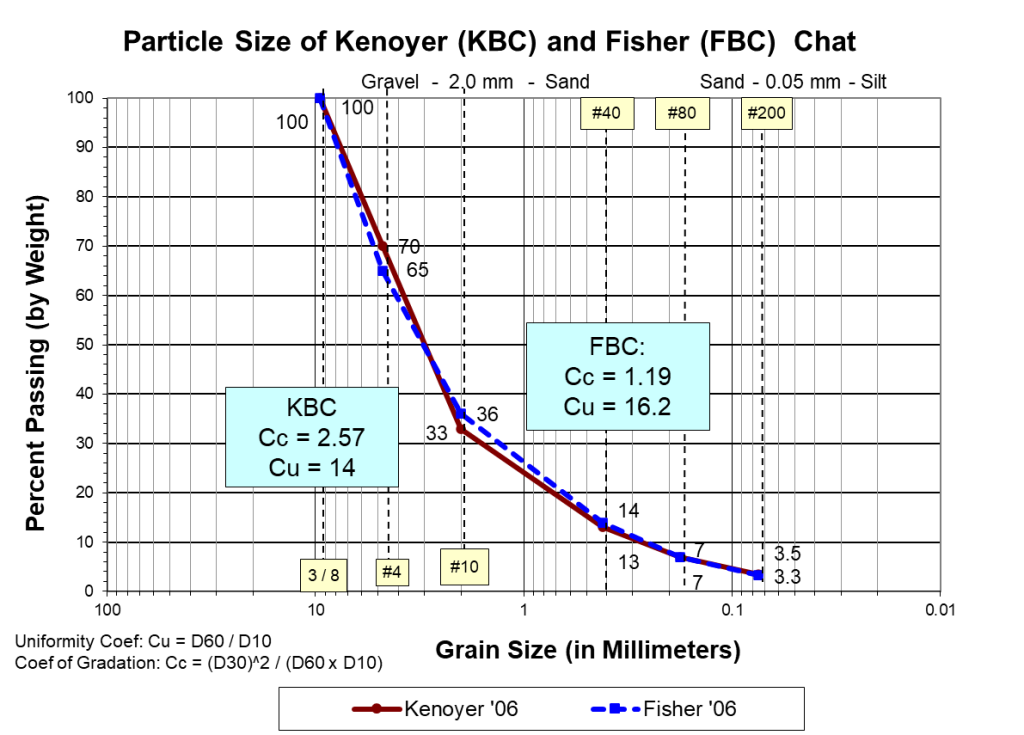
Figure 3-1. Particle-size distribution for chat samples from two chat piles at the Tar Creek Superfund Site.
Source: Oklahoma Department of Environmental Quality
- Density. Density measurement is used to determine the mass per unit volume of mining waste materials. It provides information about the material’s compactness and can be used to estimate its weight and volume. The density of mining waste can be measured using various methods, including the water displacement method, where the material is submerged in water and the volume of water displaced is measured, or the direct measurement method, where the mass and volume of the material are measured directly ( ASTM International 2021 [U9LW92GW] ASTM International. 2021. ASTM D7263-21. Standard Test Methods for Laboratory Determination of Density and Unit Weight of Soil Specimens. ASTM International. DOI: 10.1520/D7263-21. ).
- Porosity and permeability. Porosity and permeability assessment is used to evaluate the void spaces and the ability of fluids (such as water or air) to flow through mining waste materials. Porosity refers to the percentage of void spaces within the material, and permeability refers to the ease with which fluids can flow through the material. These properties are important for understanding the material’s ability to retain or transmit water, air, or other fluids. Porosity can be determined via methods such as the water saturation method or the mercury intrusion porosimetry method. Permeability can be assessed through laboratory tests, such as constant head or falling head permeability tests ( ASTM International 2016 [DZXSMLWL] ASTM International. 2016. ASTM D5084-16a. Standard Test Methods for Measurement of Hydraulic Conductivity of Saturated Porous Materials Using a Flexible Wall Permeameter. ASTM International. DOI: 10.1520/D5084-16A. ; ASTM International 2018 [99IQ3XVV] ASTM International. 2018. ASTM D4404-18. Standard Test Method for Determination of Pore Volume and Pore Volume Distribution of Soil and Rock by Mercury Intrusion Porosimetry. ASTM International. DOI: 10.1520/D4404-18. ; ASTM International 2022 [JBFUQEKL] ASTM International. 2022. ASTM D2434-22. Standard Test Methods for Measurement of Hydraulic Conductivity of Coarse-Grained Soils. ASTM International. https://doi.org/10.1520/D2434-22. ).
- Compaction. Compaction testing is used to evaluate the ability of mining waste materials to be compacted to achieve a desired density. Compaction is important for waste management and engineering purposes, as it can affect stability, settlement, and permeability. The testing involves compacting the waste material using standardized procedures, such as the Proctor compaction test or the modified Proctor compaction test. The compaction process involves applying a specified amount of energy to the material and measuring the resulting density. The test results provide information about the material’s compaction characteristics, including the optimum moisture content and maximum dry density ( ASTM International 2021 [3C67J94D] ASTM International. 2021. ASTM D698-12R21. Standard Test Methods for Laboratory Compaction Characteristics of Soil Using Standard Effort. ASTM International. DOI: 10.1520/D0698-12R21. ASTM International 2021 [6D8UB8P7] ASTM International. 2021. ASTM D1557-12R21. Standard Test Methods for Laboratory Compaction Characteristics of Soil Using Modified Effort. ASTM International. DOI: 10.1520/D1557-12R21. ).
- Durability and hardness. Common test methods include abrasion testing, compressive strength testing, Mohs hardness scale testing, and Rockwell hardness testing. Abrasion testing involves subjecting the waste material to abrasive forces, such as rubbing or grinding, and measuring the amount of material loss and provides an indication of the material’s durability and resistance to wear. Compressive strength testing measures the ability of mining waste to withstand compressive forces by applying a gradually increasing load to a sample of the waste material and measuring the maximum load it can withstand before failure. The Mohs hardness scale is a qualitative scale that ranks minerals based on their relative hardness. Rockwell hardness is a quantitative test that measures the hardness of a material by measuring the depth of penetration of an indenter under a specific load ( ASTM International 2020 [TKWK84QX] ASTM International. 2020. ASTM C1895-20. Standard Test Method for Determination of Mohs Scratch Hardness. ASTM International. DOI: 10.1520/C1895-20. ; ASTM International 2022 [EF6QSJCP] ASTM International. 2022. ASTM E18-22. Standard Test Methods for Rockwell Hardness of Metallic Materials. ASTM International. DOI: 10.1520/E0018-22. ).
- Density, turbidity, and solids content in liquids. There are extensive methodologies for the analysis of water and wastewater ( APHA et al. 2023 [945V9BC7] APHA, AWWA, and WEF. 2023. Standard Methods for the Examination of Water and Wastewater. 24th ed. Edited by E. B. Braun-Howland and T. E. Baxter. American Public Health Association. ). Physical properties of interest for solids recovery of mining-impacted waters include density, turbidity, and solids that are dissolved and suspended. As with solids, density is a measurement of mass per unit volume. Turbidity, total dissolved solids, and total suspended solids provide information regarding particulates of different sizes and solubility. These solids can be removed by different physical and chemical properties for water treatment and material recovery ( APHA 2017 [RT5WAVYG] APHA. 2017. “2130 TURBIDITY.” In Standard Methods for the Examination of Water and Wastewater. American Public Health Association. https://doi.org/10.2105/SMWW.2882.018. ; APHA 2017 [HFS7QGR6] APHA. 2017. “2540 SOLIDS.” In Standard Methods for the Examination of Water and Wastewater. American Public Health Association. https://doi.org/10.2105/SMWW.2882.030. ; ASTM International 2018 [82DJYMVD] ASTM International. 2018. ASTM D7777-13R18E01. Standard Test Method for Density, Relative Density, or API Gravity of Liquid Petroleum by Portable Digital Density Meter. ASTM International. DOI: 10.1520/D7777-13R18E01. ; ASTM International 2022 [J6K5A75R] ASTM International. 2022. ASTM D4052-22. Standard Test Method for Density, Relative Density, and API Gravity of Liquids by Digital Density Meter. ASTM International. DOI: 10.1520/D4052-22. ).
3.1.4.2 Geochemical Characterization Methods
Geochemical testing methods, such as X-ray fluorescence (XRF), inductively coupled plasma (ICP), inductively coupled plasma–mass spectrometry (ICP-MS), and atomic absorption spectrometry (AAS), are commonly used to analyze the chemical composition of mining waste. These methods provide valuable information about the presence and concentration of various elements in the waste material.
- X-ray fluorescence (XRF). XRF is a nondestructive analytical technique that measures the elemental composition of a sample. It works by bombarding the sample with X-rays, which causes the atoms in the sample to emit characteristic fluorescent X-rays. The emitted X-rays are then detected and analyzed to determine the elemental composition of the sample. XRF is widely used in mining waste analysis to determine the concentrations of major and trace elements ( ASTM International 2022 [IVNNFYJQ] ASTM International. 2022. ASTM E1621-22. Standard Guide for Elemental Analysis by Wavelength Dispersive X-Ray Fluorescence Spectrometry. ASTM International. DOI: 10.1520/E1621-22. ; USEPA 2007 [QE8Y9QIY] USEPA. 2007. SW-846 Test Method 6200: Field Portable X-Ray Fluorescence Spectrometry for the Determination of Elemental Concentrations in Soil and Sediment. U.S. Environmental Protection Agency. https://www.epa.gov/hw-sw846/sw-846-test-method-6200-field-portable-x-ray-fluorescence-spectrometry-determination. ).
- Inductively coupled plasma (ICP). ICP is a technique used to ionize elements in a digested or dissolved sample to measure their chemical concentrations. It involves introducing the sample into a high-temperature plasma (a gas that has been heated to a very high temperature) where the atoms are ionized. The ionized atoms are then quantified using optical emission spectrometry (OES) or MS.
- Inductively coupled plasma–optical emission spectrometry (ICP-OES). ICP-OES employs ICP to produce excited atoms or ions that produce electromagnetic radiation; this radiation is specific to individual elements. The intensity of detection is correlated to concentrations of elements in the sample, which can all be measured simultaneously. ICP-OES is widely used for metals and trace element detection as well as minerals processing to provide data on the material grade. ICP-OES is also known as ICP-AES, for atomic emission spectroscopy ( USEPA 2018 [BZLMIA2L] USEPA. 2018. SW-846 Test Method 6010D: Inductively Coupled Plasma-Optical Emission Spectrometry (ICP-OES). U.S. Environmental Protection Agency. https://www.epa.gov/hw-sw846/sw-846-test-method-6010d-inductively-coupled-plasma-optical-emission-spectrometry-icp-oes. ).
- Inductively coupled plasma–mass spectrometry (ICP-MS). ICP-MS employs ICP with a mass spectrometer to atomize the sample. It allows for the simultaneous measurement of multiple elements and provides excellent sensitivity and detection limits. ICP-MS is particularly useful for the analysis of metals and nonmetals and for differentiating isotopes in liquid samples ( USEPA 2014 [6SABH2M4] USEPA. 2014. SW-846 Test Method 6020B: Inductively Coupled Plasma–Mass Spectrometry. U.S. Environmental Protection Agency. https://www.epa.gov/hw-sw846/sw-846-test-method-6020b-inductively-coupled-plasma-mass-spectrometry. ).
- Atomic absorption spectrometry (AAS). AAS is a technique that measures the absorption of light by atoms in a sample digested or dissolved in an aqueous substrate. It works by passing the light of a specific wavelength through the sample and measuring the amount of light absorbed. The absorption is directly proportional to the concentration of the element being analyzed. AAS is commonly used for the analysis of specific elements, such as metals, in mining waste ( USEPA 1998 [LTZDPJDW] USEPA. 1998. SW-846 Test Method 7010: Graphite Furnace Atomic Absorption Spectrophotometry. U.S. Environmental Protection Agency. https://www.epa.gov/sites/default/files/2015-07/documents/epa-7010.pdf. ; USEPA 2007 [RYCKLZ98] USEPA. 2007. SW-846 Test Method 7000B: Flame Atomic Absorption Spectrophotometry. U.S. Environmental Protection Agency. https://www.epa.gov/hw-sw846/sw-846-test-method-7000b-flame-atomic-absorption-spectrophotometry. ).
- High-performance liquid chromatography (HPLC). An HPLC test involves the separation of a sample into a flowing liquid (mobile phase) and sorbents within a column (stationary phase). HPLC can identify compounds present in samples that can be dissolved in liquid to trace concentrations as low as parts per trillion ( USEPA 1996 [5HZI8C42] USEPA. 1996. SW-846 Test Method 8151A: Chlorinated Herbicides by Gas Chromatography (GC) Using Methylation or Pentafluorobenzylation Derivatization. U.S. Environmental Protection Agency. https://www.epa.gov/hw-sw846/sw-846-test-method-8151a-chlorinated-herbicides-gas-chromatography-gc-using-methylation-or. ).
- Synthetic precipitation leachate procedure (SPLP). SPLP is a test of the mobility of both organic and inorganic analytes present in solids, wastes, and liquids. SPLP attempts to replicate the leaching of contaminants due to weathering in situ by rain or snowmelt ( USEPA 1994 [DRY3WGV8] USEPA. 1994. SW-846 Test Method 1312: Synthetic Precipitation Leaching Procedure. U.S. Environmental Protection Agency. https://www.epa.gov/hw-sw846/sw-846-test-method-1312-synthetic-precipitation-leaching-procedure. ).
- Toxicity characteristic leachate procedure (TCLP). TCLP is a test of the mobility of both organic and inorganic analytes present in solids, wastes, and liquids. TCLP seeks to reproduce the leaching of contaminants in landfills due to exposure to typical landfill leachate ( USEPA 1992 [SCR75WC9] USEPA. 1992. SW-846 Test Method 1311: Toxicity Characteristic Leaching Procedure. U.S. Environmental Protection Agency. https://www.epa.gov/hw-sw846/sw-846-test-method-1311-toxicity-characteristic-leaching-procedure. ).
- Humidity cell testing (HCT) procedure. HCTs are laboratory-scale leachability tests that are typically performed on drill cores, mining waste, or wall rock under oxidizing conditions. Unlike short-term tests like SPLP and TCLP, HCT is a long-term leachability test conducted over a period of weeks to estimate the leachate characteristics of analyzed material ( ASTM International 2018 [Y9UD29CU] ASTM International. 2018. ASTM D5744-18. Standard Test Method for Laboratory Weathering of Solid Materials Using a Humidity Cell. ASTM International. DOI: 10.1520/D5744-18. ).
3.1.4.3 Mineralogical Characterization Methods
Mineralogical testing plays a crucial role in mining waste characterization to help understand the mineralogical composition, distribution, and potential environmental impacts of mining waste materials. Overall, mineralogical testing provides valuable data for designing effective waste management strategies and evaluating the potential for resource recovery from mining waste. Descriptions of several mineralogical testing methods is provided below:
- X-ray diffraction (XRD). XRD is a well-established technique that is used to determine mineralogy. XRD is based on how a beam of X-rays is diffracted by the crystalline structure of a mineral. The resulting diffraction patterns are compared to known minerals to identify the crystalline phases that are present. XRD analysis is typically done with a stationary instrument in a lab, but portable XRD devices have been developed to be used on-site. Lab-based instruments can give semiquantitative results but can be limited in their ability to quantify the percentage of a bulk sample or the composition. XRD has some limitations. It cannot identify amorphous phases, and it cannot provide the chemical composition of a mineral. Mineral chemistry can be determined using other methods such as electron microprobe ( Ali et al. 2023 [TK858URN] Ali, Asif, Ning Zhang, and Rafael M. Santos. 2023. “Mineral Characterization Using Scanning Electron Microscopy (SEM): A Review of the Fundamentals, Advancements, and Research Directions.” Applied Sciences 13 (23). https://doi.org/10.3390/app132312600. ).
- Scanning electron microscopy (SEM). SEM is a high-resolution imaging technique that uses a focused beam of electrons to scan the surface of a sample. It provides detailed information about the morphology, texture, and elemental composition of the minerals present in the sample. SEM can be used to identify and characterize individual mineral grains, as well as to analyze the distribution and association of minerals within the mining waste materials ( Ali et al. 2023 [TK858URN] Ali, Asif, Ning Zhang, and Rafael M. Santos. 2023. “Mineral Characterization Using Scanning Electron Microscopy (SEM): A Review of the Fundamentals, Advancements, and Research Directions.” Applied Sciences 13 (23). https://doi.org/10.3390/app132312600. ).
- Mineral liberation analysis. This is a quantitative mineralogical analysis technique that combines automated SEM with image analysis software. It provides detailed information about the liberation and association of minerals within a sample. Mineral liberation analysis can determine the mineralogy, grain-size distribution, and mineral liberation characteristics of mining waste materials. It is particularly useful for assessing the potential for mineral recovery from mining waste and optimizing mineral processing operations ( Gu 2003 [SASSS4LQ] Gu, Ying. 2003. “Automated Scanning Electron Microscope Based Mineral Liberation Analysis: An Introduction to JKMRC/FEI Mineral Liberation Analyser.” Journal of Minerals and Materials Characterization and Engineering 02: 33–41. https://doi.org/10.4236/jmmce.2003.21003. ).
- Petrography. Petrography yields information about relationships between ore, gangue, and secondary minerals (formed by weathering and oxidation) that may determine the suitability of a particular resource recovery technology. It can also be used to identify whether weathering has altered the outer layer of particles. Materials are assessed by chemical, physical, and mineralogical methods, including hand-sample observation and optical mineralogy of thin sections ( Perkins 2020 [Y5IGP9R5] Perkins, Dexter. 2020. “Optical Mineralogy.” In Mineralogy, 2nd ed. University of North Dakota. https://opengeology.org/Mineralogy/5-optical-mineralogy/. ).
3.1.4.4 Acid-base Accounting (ABA) Methods
ABA is a method used in the context of mining waste characterization to assess the potential for AMD from the waste material. The ABA method involves measuring and calculating the acid-producing (AP) and acid-neutralizing potential of the mining waste material. It helps in determining whether the waste material has the potential to generate acidic drainage and the extent of acid generation ( Skousen 2017 [Q5WDXDCH] Skousen, Jeff. 2017. “A Methodology for Geologic Testing for Land Disturbance: Acid-Base Accounting for Surface Mines.” Geoderma 308: 302–11. https://doi.org/10.1016/j.geoderma.2017.07.038. ). Numerous methods exist such as the Sobek, Modified Sobek, or the Lapakko methods; they can be found in the International Network of Acid Prevention’s GARD Guide, Table 51 ( INAP 2018 [IQ2M8FHL] INAP. 2018. “Global Acid Rock Drainage Guide.” Guidance Document. International Network for Acid Prevention. https://www.gardguide.com/index.php?title=Main_Page. ).
3.1.4.5 Radiological Characteristic Methods
Radiological testing methods are used to assess the presence and concentration of radioactive elements (such as uranium and thorium) in mining waste. Uranium and thorium may be present in different geologic materials such as fuel minerals, granite, monzonite, shale, and phosphates. Furthermore, certain radioactive elements (such as radium in coal) can become enriched during the processing and use of the host material (for example, coal combustion residuals). These methods help to evaluate the potential radiological hazards associated with the waste and when determining appropriate management strategies. Here are some common radiological testing methods for mining waste:
- Gamma spectrometry. Gamma spectrometry is a technique used to measure the gamma radiation emitted by radioactive isotopes in a sample. It involves placing the mining waste sample in a gamma spectrometer, which consists of a scintillation detector and a multichannel analyzer. The detector detects the gamma radiation emitted by the radioactive isotopes, and the multichannel analyzer measures the energy of the gamma rays. By analyzing the energy spectrum, the concentrations of specific radioactive isotopes, such as uranium, thorium, and their decay products, can be determined ( IAEA 2003 [J6NZGI3N] IAEA. 2003. Guidelines for Radioelement Mapping Using Gamma Ray Spectrometry Data. INTERNATIONAL ATOMIC ENERGY AGENCY. https://www.iaea.org/publications/6746/guidelines-for-radioelement-mapping-using-gamma-ray-spectrometry-data. ).
- Alpha spectrometry. Alpha spectrometry is a technique used to measure the alpha radiation emitted by radioactive isotopes in a sample. It involves dissolving the mining waste sample in an appropriate chemical solution and depositing the dissolved sample onto a detector surface. The detector measures the energy and number of alpha particles emitted by the radioactive isotopes. By analyzing the energy spectrum, the concentrations of specific alpha-emitting isotopes, such as radium and radon, can be determined ( ISO 2024 [5GYU93X5] ISO. 2024. ISO/DIS 23548. Measurement of radioactivity—Alpha-emitting radionuclides—Generic test method using alpha spectrometry. ).
- Beta counting. Beta counting is a technique used to measure the beta radiation emitted by radioactive isotopes in a sample. It involves placing the mining waste sample in a beta counter, which consists of a gas-filled detector. The detector measures the number of beta particles emitted by the radioactive isotopes. By calibrating the detector with known standards, the concentrations of specific beta-emitting isotopes, such as strontium and cesium, can be determined ( ASTM International 2024 [T2ZMHDDK] ASTM International. 2024. ASTM E1742/E1742M-18. Standard Practice for Radiographic Examination. ASTM International. DOI: 10.1520/E1742_E1742M-18. ).
- Radiographic imaging. Radiographic imaging, such as X-ray imaging or gamma imaging, is used to visualize the internal structure of mining waste and identify areas of potential radioactivity. It involves exposing the waste material to X-rays or gamma rays and capturing the transmitted radiation on a detector. The resulting image provides information about the distribution and concentration of radioactive isotopes within the waste ( ASTM International 2024 [T2ZMHDDK] ASTM International. 2024. ASTM E1742/E1742M-18. Standard Practice for Radiographic Examination. ASTM International. DOI: 10.1520/E1742_E1742M-18. ).
3.1.4.6 Toxicological Characteristic Methods
Toxicological testing of mining waste involves assessing the potential health risks associated with exposure to metals, organics, asbestos, and emerging contaminants present in the waste material. This testing is important to evaluate the potential for contamination of soil, water, and air, and to determine appropriate measures for waste management and remediation. The following methods can provide insight into the toxicological characteristics of mining waste.
- Metals testing. Metals testing involves analyzing the mining waste for the presence and concentration of toxic metals such as lead, arsenic, mercury, cadmium, and chromium. This is typically done using laboratory techniques such as ICP-MS, ICP-OES, or AAS. The results of metals testing help in assessing the potential for metal toxicity and determining the appropriate remediation measures ( USEPA 2014 [6SABH2M4] USEPA. 2014. SW-846 Test Method 6020B: Inductively Coupled Plasma–Mass Spectrometry. U.S. Environmental Protection Agency. https://www.epa.gov/hw-sw846/sw-846-test-method-6020b-inductively-coupled-plasma-mass-spectrometry. ; USEPA 2018 [X92W6S3H] USEPA. 2018. SW-846 Test Method 8260D: Volatile Organic Compounds by Gas Chromatography/Mass Spectrometry (GC/MS). U.S. Environmental Protection Agency. https://www.epa.gov/hw-sw846/sw-846-test-method-8260d-volatile-organic-compounds-gas-chromatographymass-spectrometry. ).
- Organics testing. Organics testing involves analyzing the mining waste for natural organics, such as dissolved organic carbon and chemical oxygen demand, and hazardous organic compounds, such as polycyclic aromatic hydrocarbons, volatile organic compounds, and pesticides. This is typically done using techniques such as GC-MS or HPLC. Natural organic compounds may mobilize or transform other materials under environmental conditions, such as inorganic mercury transforming to methylmercury. Organics testing helps in assessing the potential for organic compound toxicity and determining the appropriate remediation measures ( USEPA 2007 [6DXGHM73] USEPA. 2007. SW-846 Test Method 8081B: Organochlorine Pesticides by Gas Chromatography. U.S. Environmental Protection Agency. https://www.epa.gov/hw-sw846/sw-846-test-method-8081b-organochlorine-pesticides-gas-chromatography. ; USEPA 2018 [X92W6S3H] USEPA. 2018. SW-846 Test Method 8260D: Volatile Organic Compounds by Gas Chromatography/Mass Spectrometry (GC/MS). U.S. Environmental Protection Agency. https://www.epa.gov/hw-sw846/sw-846-test-method-8260d-volatile-organic-compounds-gas-chromatographymass-spectrometry. ; USEPA 2018 [V2NW4IAA] USEPA. 2018. SW-846 Test Method 8270E: Semivolatile Organic Compounds by Gas Chromatography/Mass Spectrometry. U.S. Environmental Protection Agency. https://www.epa.gov/hw-sw846/sw-846-test-method-8270d-semivolatile-organic-compounds-gas-chromatographymass-spectrometry. ).
- Asbestos testing. Asbestos testing involves analyzing the mining waste for the presence of asbestos fibers. Asbestos is a group of naturally occurring minerals that can cause serious health issues when inhaled. The testing typically involves microscopic examination of the waste material to identify and quantify asbestos fibers. Asbestos testing helps in assessing the potential for asbestos-related health risks and determining the appropriate remediation measures ( ASTM International 2022 [EK6KU39S] ASTM International. 2022. ASTM D7521-22. Standard Test Method for Determination of Asbestos in Soil. ASTM International. DOI: 10.1520/D7521-22. ).
- Leachability testing. Leachability testing is conducted to assess the potential for contaminants to leach out of the mining waste material and contaminate the surrounding environment, such as soil and groundwater. This testing is important to evaluate the mobility and potential for migration of contaminants. Leachability testing involves subjecting the waste material to specific leaching conditions, simulating different environmental scenarios. The leachate is then analyzed for the presence and concentration of contaminants. Common leachability tests include TCLP and SPLP. Kinetic tests, such as HCT, are long-term dynamic leaching tests that mimic on-site variable geologic and weathering conditions of the waste rock or tailings. HCT tests reduce the uncertainty of the static leach tests ( Maest and Nordstrom 2017 [Y93JSZF5] Maest, Ann S., and D. Kirk Nordstrom. 2017. “A Geochemical Examination of Humidity Cell Tests.” https://doi.org/10.1016/j.apgeochem.2017.03.016. ). The results of leachability testing help in determining the appropriate waste management strategies, such as containment, treatment, or disposal. The results also aid in assessing the potential for environmental impacts and the need for remediation measures to protect human health and the environment ( USEPA 1992 [SCR75WC9] USEPA. 1992. SW-846 Test Method 1311: Toxicity Characteristic Leaching Procedure. U.S. Environmental Protection Agency. https://www.epa.gov/hw-sw846/sw-846-test-method-1311-toxicity-characteristic-leaching-procedure. ; USEPA 1994 [DRY3WGV8] USEPA. 1994. SW-846 Test Method 1312: Synthetic Precipitation Leaching Procedure. U.S. Environmental Protection Agency. https://www.epa.gov/hw-sw846/sw-846-test-method-1312-synthetic-precipitation-leaching-procedure. ).
3.2 Economic and Market Considerations
The reuse of solid mining waste requires understanding the balance between what is technically achievable, economically feasible, and socially and environmentally acceptable. Project costs depend on the status of the mine and the goals of the responsible party considering solid mining waste reuse. Ideally, reuse of solid mining waste will generate income by creating a financial asset through additional resource recovery or product development and reduce potential remediation costs or long-term liability, rather than create a liability for a responsible party. However, the viability of a potential reuse project is commonly driven by economic, geopolitical, and market considerations, which can change rapidly ( ITRC 2010 [TVXDREGF] ITRC. 2010. “Mining Waste Treatment Technology Selection.” Interstate Technology and Regulatory Council. https://projects.itrcweb.org/miningwaste-guidance/index.htm. ). Therefore, it is recommended that an economic and technical feasibility evaluation be performed to assess market conditions, technology effectiveness and safety, vendor reliability, and availability.
Several components to consider when performing an economic and technical feasibility evaluation include but are not limited to the following:
- Quantity of the mining waste material. The amount of material that is available for potential reuse is a common limiting factor when assessing the viability of a reuse project.
- Quality of the mining waste material. The quality of the mining waste material is a major factor in determining its potential for resource recovery. For example, the metals concentration, or grade, within the waste material has a direct influence on whether it is technically and economically viable to extract further minerals. The higher the grade of ore, the higher the economic feasibility of the overall project.
- Site access and rights. Mineral and surface rights and permitting may be factors in cost evaluations for a potential site. See Section 6.2.8 for an example.
- Location of the mining waste in relation to the processing equipment or facility. A site may or may not have the space for necessary processing equipment. A unique waste composition may require more specialized processing, which could require a specialized facility rather than purchasing the equipment to conduct the processing on-site. Waste may have to be transported to a location for treatment and processing before reuse. See Section 6.2.7 for an example.
- Location of the mining waste material in relation to the beneficial reuse location or facility. A location that is remote and difficult to access can pose practical constraints on equipment and activities and increase transportation costs. For reuse of mining waste as construction materials or aggregate, the mining waste must typically be located within a reasonable proximity of urban areas or construction projects requiring the material ( ITRC 2010 [TVXDREGF] ITRC. 2010. “Mining Waste Treatment Technology Selection.” Interstate Technology and Regulatory Council. https://projects.itrcweb.org/miningwaste-guidance/index.htm. ).
- Regulatory requirements. The source and composition of a waste considered for reuse may or may not be restricted by federal, state, or local regulations, which can affect the cost for treatment and processing and the overall viability of a project. If the site or material is considered contaminated, treatment will be required to reduce contamination to required levels; however, resource recovery opportunities may offset the cost of treatment. See Section 3.4 for more information on regulatory considerations.
- Processing and technology costs. Different treatment processes will have different associated costs for solid mining waste reuse. See Section 5 for more information.
- Buyer landscape. The mining waste owner should survey interested buyers to identify needs for particular products that can be generated from solid mining waste. For example, REEs may need to be in specific forms for processing, and buyers may have needs and expectations when purchasing a recovered resource that affects the price.
- Geopolitical effects on minerals and commodities. Geopolitical risks, such as political instability and military conflicts or threats that can have regional or global impacts, can drive market demand associated with metal and mineral sales. Abundant resources (in other words, a flooded market) may limit the feasibility of a reuse project whereas a strong demand can make the reuse project economically viable.
- Incentives for reuse of mining waste. Grants, tax incentives, or other incentives may be available from local, state, or federal governments or from private sector and nonprofit groups to offset limitations such as cost associated with reuse of solid mining waste. The Infrastructure Investment and Jobs Act (a.k.a. Bipartisan Infrastructure Law [BIL]) enacted November 21, 2021, has provided funding for the U.S. Department of Energy (USDOE), U.S. Department of Defense (DOD), the U.S. Department of the Interior (USDOI), and the USEPA in part to address issues related to mining waste (U.S. Congress 2021). Mining activity status can determine eligibility for other incentives, such as abandoned mine programs ( USEPA 2024 [YV3EHQ3Q] USEPA. 2024. “Biden-Harris Administration Announces over $1 Billion to Start New Cleanup Projects and Continue Work at 100 Superfund Sites across the Country.” U.S. Environmental Protection Agency. https://www.epa.gov/newsreleases/biden-harris-administration-announces-over-1-billion-start-new-cleanup-projects-and. ). Incentives may be through mining waste cleanup programs ( USEPA 2024 [YV3EHQ3Q] USEPA. 2024. “Biden-Harris Administration Announces over $1 Billion to Start New Cleanup Projects and Continue Work at 100 Superfund Sites across the Country.” U.S. Environmental Protection Agency. https://www.epa.gov/newsreleases/biden-harris-administration-announces-over-1-billion-start-new-cleanup-projects-and. ; USDOI 2024 [34A6DMLW] USDOI. 2024. “Abandoned Mine Land Economic Revitalization (AMLER) Program.” U.S. Department of the Interior, Office of Surface Mining Reclamation and Enforcement. https://www.osmre.gov/programs/reclaiming-abandoned-mine-lands/amler. ); critical mineral research and production, such as REEs ( USDOE 2022 [5US7ZM5Q] USDOE. 2022. “Biden-Harris Administration Announces $156 Million for America’s First-of-a-Kind Critical Minerals Refinery.” U.S. Department of Energy. https://www.energy.gov/articles/biden-harris-administration-announces-156-million-americas-first-kind-critical-minerals. ; USDOE 2023 [BUQGFSHI] USDOE. 2023. “DOE Invests $32M for Projects to Study Production of Critical Minerals and Materials from Coal-Based Resources.” DOE Invests $32M for Projects to Study Production of Critical Minerals and Materials from Coal-Based Resources. https://netl.doe.gov/node/12700. ; USGS 2022 [APF3Z9XW] USGS. 2022. “Biden-Harris Administration Invests Over $74 Million in Federal-State Partnership for Critical Minerals Mapping.” U.S. Geological Survey. https://www.usgs.gov/news/national-news-release/biden-harris-administration-invests-over-74-million-federal-state. ); or land reuse programs, such as renewable power generation ( Macknick et al. 2013 [DIXNQZSP] Macknick, Jordan, Courtney Lee, and Jenny Melius. 2013. “Solar Development on Contaminated and Disturbed Lands. NREL/TP-6A20-58485.” National Renewable Energy Laboratory. https://www.nrel.gov/docs/fy14osti/58485.pdf. ; USEPA 2011 [NTUT2W2E] USEPA. 2011. “Shining Light on a Bright Opportunity. Developing Solar Energy on Abandoned Mine Lands.” U.S. Environmental Protection Agency. ttps://semspub.epa.gov/work/11/176032.pdf. ; USEPA 2012 [PN9QNDJP] USEPA. 2012. “A Breath of Fresh Air for America’s Abandoned Mine Lands. Alternative Energy Provides a Second Wind.” U.S. Environmental Protection Agency. https://semspub.epa.gov/work/11/176038.pdf. ).
3.3 Life-Cycle Analysis and Risk Assessment
Mining and metallurgical activities produce a considerable amount of waste that contains metals, metalloids, and other contaminants. As a result, mining waste facilities are associated with soil, surface water, and groundwater contamination that can pose a significant risk to both human health and the environment ( Karachaliou et al. 2016 [ZGBCK3QT] Karachaliou, Theodora, Vasileios Protonotarios, Dimitris Kaliampakos, and Maria Menegaki. 2016. “Using Risk Assessment and Management Approaches to Develop Cost-Effective and Sustainable Mine Waste Management Strategies.” Recycling 1 (3): 328–42. https://doi.org/10.3390/recycling1030328. ). To minimize impacts, a comprehensive LCA and risk assessment and management approach allows for the selection of measures to minimize health hazards, use the site for new purposes, and secure the opportunity for resource recovery ( Karachaliou et al. 2016 [ZGBCK3QT] Karachaliou, Theodora, Vasileios Protonotarios, Dimitris Kaliampakos, and Maria Menegaki. 2016. “Using Risk Assessment and Management Approaches to Develop Cost-Effective and Sustainable Mine Waste Management Strategies.” Recycling 1 (3): 328–42. https://doi.org/10.3390/recycling1030328. ).
Regardless of on-site or off-site reuses, it would be inappropriate to reuse mining wastes in a manner that leaves the material in a condition that may adversely affect human health or the environment. Solid mining waste includes different types of hazards, from physical hazards, such as dust, to toxicological hazards, such as metals, which can be released into the surrounding air, soil, and water without proper management (see Section 2.4). These hazards may persist or transform following the reuse of solid mining waste in another application in both short- and long-term durations. These hazards can cause harm to ecological receptors through the food chain, such as through bioaccumulation of metals ( Das et al. 2023 [FFQF6UD8] Das, Alok Prasad, Megharaj Mallavarapu, and Shreya Ghosh. 2023. “Ecotoxicity of Mining Pollutants on the Environment and Their Remediation.” Environmental Chemistry and Ecotoxicology 5. https://doi.org/10.1016/j.enceco.2023.08.002. ). To humans, these hazards can manifest themselves in acute or chronic manners resulting in a variety of diseases including but not limited to respiratory, cardiovascular, neurodegenerative, cancers, and chronic inflammation ( Silva-Rêgo et al. 2022 [J23JZS6Y] Silva-Rêgo, Leonardo Lucas da, Leonardo Augusto Almeida, and Juciano Gasparotto. 2022. “Toxicological Effects of Mining Hazard Elements.” Energy Geoscience 3 (3): 255–62. https://doi.org/10.1016/j.engeos.2022.03.003. ). Any reuse of solid mining waste must evaluate the potential environmental implications of the specific waste, processing, and reuse application to protect human health and the environment.
3.3.1 Life-Cycle Analysis
An LCA of mining waste measures the environmental impact of a material from extraction to end-of-life disposal. LCA considers all of the inputs and outputs of materials, energy, water, and emissions that occur in each stage of the life cycle and assesses their potential effects on different environmental impact categories, such as climate change, acidification, eutrophication, human toxicity, and land use. LCA is important in understanding the environmental implications of decisions and actions for mining operations. LCA can allow for comparison of various scenarios for potential use and disposal of mining waste, as well as comparison to new mining for needed resources; these scenarios can illustrate trade-offs in terms of different impact categories, such as carbon footprint, water consumption, or human or ecological toxicity ( Biondini and Frangopol 2023 [LUJ3XAM2] Biondini, Fabio, and Dan M. Frangopol, eds. 2023. “Life-Cycle of Structures and Infrastructure Systems.” In Proceedings of the Eighth International Symposium on Life-Cycle Civil Engineering. Politecnico Di. CRC Press. https://doi.org/10.1201/9781003323020. ). LCA is also used to identify possible improvements throughout the different stages of a product. For additional information on LCA, see the ISO Standard on Environmental Management—Life Cycle Assessment ISO 2020 ( ISO 2020 [3UNHREFY] ISO. 2020. “Environmental Management — Life Cycle Assessment — Principles and Framework. Amendment 1.” ISO 14040 (2006). https://www.iso.org/standard/76121.html. ).
The development of a site-specific LCA differentiates the impacts occurring at a given location. Site-specific environmental impact assessment models increase the level of detail and accuracy of environmental assessments ( Yao et al. 2021 [UUCR3WLT] Yao, Kouadio Assemien François, Blaise Koffi Yao, Olivier Belcourt, et al. 2021. “Mining Impacts Assessment Using the LCA Methodology: Case Study of Afema Gold Mine in Ivory Coast.” Integrated Environmental Assessment and Management 17 (2): 465–79. https://doi.org/10.1002/ieam.4336. ). LCAs have limited use for mining waste in part due to the difficulty of quantifying the various inputs and outputs involved (zotpress items=”{4889498:UEZKM5UM}” style=”chicago-author-date”]); however, the development of a rigorous mining-specific LCA framework can support data collection that covers the temporal and spatial dimensions of mining ( Awuah-Offei and Adekpedjou 2011 [PT3FJYK9] Awuah-Offei, Kwame, and Akim Adekpedjou. 2011. “Application of Life Cycle Assessment in the Mining Industry.” The International Journal of Life Cycle Assessment 16 (1): 82–89. https://doi.org/10.1007/s11367-010-0246-6. ). For instance, Yao et al. ( Yao et al. 2021 [UUCR3WLT] Yao, Kouadio Assemien François, Blaise Koffi Yao, Olivier Belcourt, et al. 2021. “Mining Impacts Assessment Using the LCA Methodology: Case Study of Afema Gold Mine in Ivory Coast.” Integrated Environmental Assessment and Management 17 (2): 465–79. https://doi.org/10.1002/ieam.4336. ) assessed the environmental impacts of a gold mine to determine the importance of off-site effects. The areas of protection were human health, ecosystem quality, and resource depletion. The results of the study confirmed the importance of considering both on-site and off-site impacts and the pertinence of including the LCA perspective in mining environmental impact assessments.
3.3.2 Ecological and Human Health Risk Assessment
The opportunities for solid mining waste reuse may be limited because of unacceptable risks to human health and the environment. Human health risks may be determined for residential, recreation, or industrial exposures. Environmental risks can be determined for broad groups of aquatic and terrestrial receptors or for specific species. Formal LCAs and risk assessments may be required under regulatory requirements, depending on the status of the site and applicable jurisdiction. To learn more about risk assessment, see USEPA’s risk assessment resources ( USEPA 2024 [QDCKEXYQ] USEPA. 2024. “Risk Assessment.” U.S. Environmental Protection Agency. https://www.epa.gov/risk. ), as well as the Interstate Technology & Regulatory Council’s (ITRC’s) risk assessment resources ( ITRC 2023 [CM8MA36X] ITRC. 2023. “Risk Assessment Resources.” https://itrcweb.org/teams/projects/risk-assessment-resources. ).
An assessment of the potential impacts and risks associated with mining waste reuse and reprocessing alternatives should be developed and considered when selecting methods for processing and final applications. This assessment should examine potential impacts and risks over the life cycle of the reuse or reprocessing, including potential releases to the environment and exposures to workers and the public during these stages, as applicable:
- Excavation and handling of material at its source
- Transport to a location for reuse or reprocessing
- Storage and handling at reuse or reprocessing location
- By-products or waste from reprocessing (for example, residual after extraction)
- Transport of product incorporating reused or reprocessed waste to the point of use
- Possible exposures associated with product use (for example, using cement with waste added)
- End-of-life of repurposed waste or product incorporating waste (for example, landfill, road foundation)
The assessment should include all contaminants and potential exposure pathways, the site condition and potential geochemistry changes that can occur following waste excavation for repurposing, and whether processing results in new or increased or decreased risks from the material or its residuals. It should also consider new human and ecological exposure pathways that may result from repurposing, reuse, or reprocessing. For example, is the material now more available for release to surface water, does the new use result in human dust exposures at new locations, or is the waste being reused in a product with reduced leaching potential, resulting in overall reduced risk and improvement of the site? In cases where reuse is a substitute for other material, for example agricultural lime, it is possible that the impacts and risks of use and beyond in the life cycle are no greater than the current practices. Consideration should be given to impacts and risks up to that point, including considering whether the source of the waste now has new potential impacts.
Although risk assessment estimates are subject to uncertainty, the risk-based approach provides a formal basis for evaluating and ranking potential hazards with respect to a branch of factors (for example, economic, social, political). Moreover, a risk assessment prioritizes local conditions and needs and directs the proposed solution toward the most suitable site- and time-specific actions so that the site is safe for its users until technological advancements and economic developments make the recovery of stored materials feasible. Beyond the mining waste, environmental risks may also be present at the site due to mining operation impacts, such as lubricant spills, PCBs (polychlorinated biphenyls), and residual dynamite from blasting, that impact the overall risk of a solid mining waste reuse project. Finally, a risk assessment assimilates different kinds of technical and nontechnical information, helps all parties involved (for example, competent authorities, site managers, and the public) understand the true dimensions of the problem, and thus minimizes any delays in the remediation actions required ( Karachaliou et al. 2016 [ZGBCK3QT] Karachaliou, Theodora, Vasileios Protonotarios, Dimitris Kaliampakos, and Maria Menegaki. 2016. “Using Risk Assessment and Management Approaches to Develop Cost-Effective and Sustainable Mine Waste Management Strategies.” Recycling 1 (3): 328–42. https://doi.org/10.3390/recycling1030328. ). See Sections 6.1.1.1 and 6.2.1.
3.4 Regulatory Considerations
This section focuses on the environmental review, cultural resource, and regulatory considerations for mining and mining waste reuse within the United States. Mining sites and their associated wastes are located in varied environments and are subject to variable federal, state, and tribal regulations and authorities. These requirements depend on the site mining activity status (Section 3.4.1) and ownership of mineral and surface rights (Section 3.4.2), as well as environmental (Section 3.4.3) and cultural resource considerations (Section 3.4.4) that influence what regulations apply to a particular site. The site could be an active mine, an inactive mine, a closed mine, or an abandoned mine. The site could include surface or mineral rights that may be leased or owned by different parties than the operators. Additionally, the site could be environmentally benign or have contaminants hazardous to ecological receptors or human health. Navigating the pathway to reusing solid mining waste will be site specific. The following sections offer a more detailed discussion of the important characteristics to consider when evaluating the regulatory landscape of a potential reuse project. Figure 3-2 depicts federal regulatory acts related to mining waste reuse.
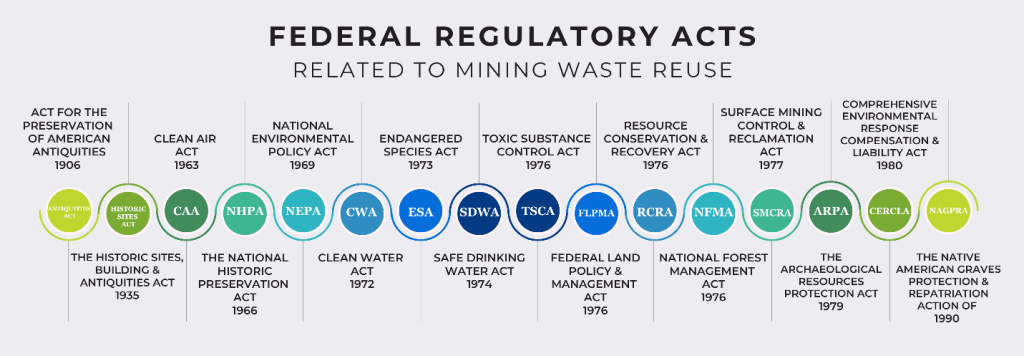
Figure 3-2. Federal regulatory acts related to mining waste reuse.
Source: Jessica Rayfield, Alabama Department of Environmental Management
Activities regarding worker health and safety, including waste characterization and processing, are governed under applicable regulations administered by the Mine Safety and Health Administration (MSHA) and the Occupational Safety and Health Agency; these regulations will not be discussed within this document.
3.4.1 Mining Activity Status
A mining site is defined by its mining activity status. The definitions of site activity may vary based on the regulatory authority or may be specific to an applicable program. This document categorizes mine sites as active mines, inactive mines, abandoned mines, or closed mines. Generally, for solid mining waste reuse, it is critical to determine whether the site is abandoned and whether a potentially responsible party (PRP) can be identified. If the site is abandoned, additional incentive programs are available that could provide funds for reclamation, which may include solid mining waste reuse as a strategy (see Section 4.3.3).
3.4.2 Ownership Rights – Mineral, Surface, and Water
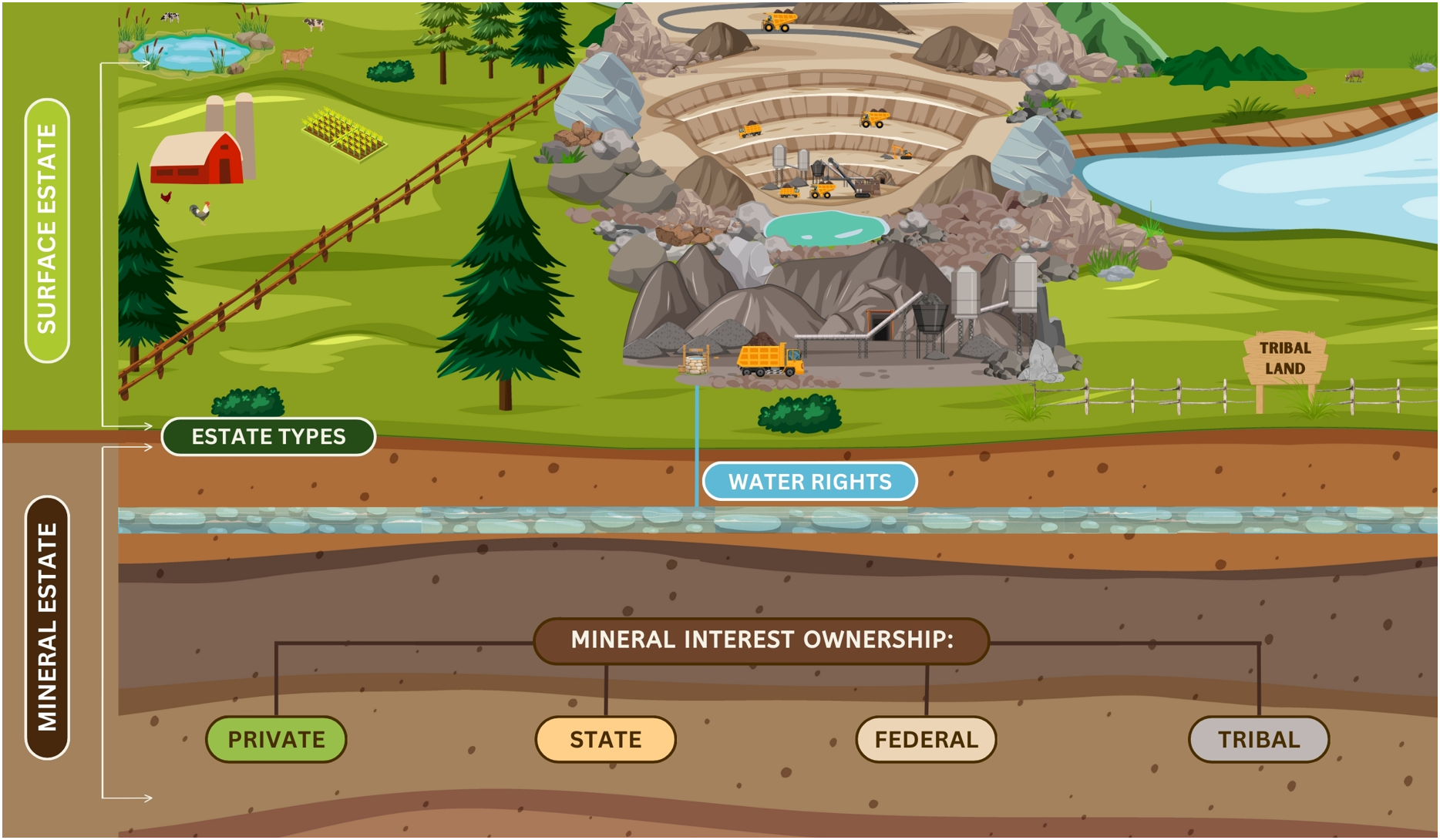
The mineral and surface rights of a site may be held by no parties, one party, or multiple parties. Depending on land ownership and resource type, these rights may be owned or leased. Leased rights may have production requirements or may be limited to a set time frame. Due diligence should always be conducted to determine who owns the surface and mineral rights of a given site during the planning phase ( BLM 2024 [U6F5LDER] BLM. 2024. “About Mining and Minerals.” U.S. Bureau of Land Management. https://www.blm.gov/programs/energy-and-minerals/mining-and-minerals/about. ). A summary of different types of rights to be considered is shown in Figure 3-3. Figure 3-3 is an active graphic—select text on the diagram to read more about the particular type of rights. See Section 3.4.2.2 for a detailed discussion on mineral and surface rights.
Estate Types
Fee Simple or United Estate:
The surface & mineral rights are joined. The executive rights holder has control over both estates.
Severed or Split Estate:
The surface & mineral rights are separate. It is a fractional estate when the mineral rights are divided among multiple owners.
Water Rights
In the U.S., the use of water is controlled by the states. Typically, states have requirements regarding the use of water for mining-related activities. The specific requirements depend on the volume, quality, location, & type of water to be used.
Surface water rights may be granted if the project lies on lands bordering a natural waterway. The mining company may be required to own the lands to obtain surface water rights.
Groundwater rights may be granted if available in the project area. However, it's important to note that some basins have been allocated, and no new rights are available. Rights not exercised in some time may be denied for use.
Prospective mine waste reuse projects should carefully evaluate water requirements & availability. Community interest may be a significant factor, especially in water-scarce regions.
Surface Estate
Surface rights allow the owner to use the surface of the land for commercial, residential, agricultural, and other purposes, such as building, gardening, raising livestock, etc. Surface rights can encompass ownership, leasing, and various types of agreements that govern how the surface of the land can be used.
Mineral Estate
Mineral rights authorize the owner to explore, extract, and develop resources beneath the land’s surface, such as oil wells, mineral deposits, natural gas, etc. The mineral owner may also choose to lease, sell, or donate the mineral rights to an individual or company.
Private
Private mineral ownership is by individuals, companies, or organizations on privately owned land who purchase or inherit mineral rights.
Leasable minerals (oil, gas, coal): owners can lease their mineral rights to companies, retaining some rights while receiving royalties
Locatable minerals (metallic/nonmetallic minerals): owners can stake a claim and acquire rights separately from the surface rights; owners control the rights to extract minerals or to lease their rights to mining companies
Saleable minerals (common materials, sand, gravel): owners control minerals through permits & leases, extracting & selling the materials, or leasing the rights to companies to extract
Royalties can be negotiated with the companies extracting the minerals from their land and are usually based on the extracted quantity or value.
State
Some states retain ownership of minerals within their boundaries.
Leasable minerals (oil, gas, coal): states lease these minerals through lease agreements, often through competitive bidding processes
Locatable minerals (metallic/nonmetallic minerals): a mining claim can be made on these minerals, and once established the minerals can be extracted; minerals on state-owned land are made available under the individual state’s statutory and regulatory scheme
Saleable minerals (common materials, sand, gravel): on state-owned lands, these minerals can be permitted for extraction & usually with royalties paid to the state
Royalties from both leased & saleable material extracted from state-owned land are paid to the state government. Interests involve the rights given to companies to extract minerals.
Federal
Typically, the federal government retains ownership of minerals on federally owned lands.
Leasable minerals (oil, gas, coal): the federal government manages these minerals through agencies that lease rights to extraction companies through competitive bidding which must adhere to certain regulations set by agencies such as the Bureau of Land Management (BLM) or the Forest Service (USFS)
Locatable minerals (metallic/nonmetallic minerals): on federal lands, these minerals may require individuals or companies to stake claims or obtain permits for extraction; claims require maintenance fees and assessment work to maintain
Saleable minerals (common materials, sand, gravel): permits or leases manage these minerals to grant their extraction on federal lands, and royalties are paid to the federal government
Royalties from minerals extracted on federal lands are paid to the federal government, and revenue-sharing agreements allocate some of the royalties to the states where the mineral extraction occurred. Interests involve the rights granted to companies to extract materials while paying the government through royalties.
Tribal
Reservations on Federal lands in the U.S. are held by a treaty or administrative directive for specific Native American tribes or Alaska Natives, and the federal government holds title to the land in trust/restricted status for the benefit of a tribe or individual tribal member.
Leasable minerals: on Indian land, these minerals are owned by Native American tribes or individual tribal members and are subject to restrictions on leasing and development imposed by the federal government
Locatable minerals: on Indian land, these refer to valuable mineral resources that are subject to exploration and extraction under the General Mining Law of 1872; these minerals are typically owned by Native American tribes or individual tribal members and are governed by federal regulations and tribal ordinances
Saleable minerals: on Indian land, these minerals are owned by Native American tribes or individual tribal members and are suitable for extraction and sale in commercial markets; these minerals may include, but are not limited to, a variety of valuable resources such as oil, natural gas, coal, gravel, and sand and are subject to restrictions on sales and development imposed by the federal government
Royalties from extracted minerals are paid to the tribal government or designated managing body and distributed within the tribe. The Bureau of Indian Affairs (BIA) and other federal agencies may be involved in overseeing and managing the extraction process. The interests in extracting minerals from tribal lands are diverse and include economic, legal, environmental, and cultural dimensions.
Figure 3-3. Mining mineral interest ownership.
Source: Jessica Rayfield, Alabama Department of Environmental Management
3.4.2.1 Mineral Law
A detailed history of mineral law is beyond the scope of this document; however, a brief summary of mineral laws may be helpful in understanding the connection between mining and reusing mining waste at former and future mine sites.
The Mining Law of 1872 sets the stage for the exploration and acquisition of valuable mineral deposits in the United States. The interest in these materials led to subsequent laws, including the Mineral Leasing Act of 1920, the Materials Act of 1947, and the Mining and Mineral Policy Act of 1970. These federal laws are instrumental in promoting the development of a stable and lucrative mining sector while developing sustainable and responsible methods of mineral extraction and processing. Though the mining laws do not specifically cover reuse of mining waste, understanding mining law and subsequent mining practices may help identify opportunities for solid mining waste reuse.
A foundation for preventing needless or excessive degradation of public lands during mining and reclamation under the Mining Law is provided by the Bureau of Land Management (BLM) surface management regulations, issued under the Federal Land Policy and Management Act in 1981 and updated in 2001 ( USDOI 1976 [ZQXW5ZVE] USDOI. 1976. “The Federal Land Policy and Management Act of 1976, as Amended.” U.S. Department of the Interior. https://www.blm.gov/sites/default/files/AboutUs_LawsandRegs_FLPMA.pdf. ). The National Historic Preservation Act (NHPA), the Endangered Species Act ( USFWS 1973 [I3PIY9ZM] USFWS. 1973. “Endangered Species Act | U.S. Fish & Wildlife Service.” Endangered Species Act | U.S. Fish & Wildlife Service. https://www.fws.gov/law/endangered-species-act. ), the National Forest Management Act ( USFS 1976 [4YP7AJ57] The National Forest Management Act of 1976 (1976). https://www.fs.usda.gov/emc/nfma/includes/NFMA1976.pdf. ), the Clean Water Act, the Clean Air Act, and other state and federal laws ensure that mining activities on public lands are conducted in environmentally responsible ways. Although the National Environmental Policy Act (NEPA) applies generally to mining on federal lands and mining of federally managed minerals, it does not apply to activities that cause little or no disturbance of public lands or resources. For mining and exploration activities, it is prudent to work with the BLM District or Field Office with jurisdiction over the land involved to ensure compliance with all federal requirements.
3.4.2.2 Mineral and Surface Rights
Understanding mineral rights is a crucial part of efficiently and effectively exploring the reuse of mining waste. Mineral rights can encompass various below-the-surface resources such as oil, natural gas, gold, silver, copper, iron, coal, uranium, and other minerals. Due to the long history and complexity of distribution of mineral rights in the United States, multiple mineral rights holders may be vested in different minerals within the same mining waste, and each rights holder could expect compensation or royalties from the extraction, use, or reuse of those minerals. Before reusing solid mining waste, any interested party should conduct a detailed search and seek legal counsel to determine the rights to all minerals known or potentially contained within the waste.
The rights to the minerals must be held to allow for the exploration of minerals found underneath the surface of a property (see Section 6.2.8). Surface rights differ from mineral rights in that surface rights allow ownership and control over only the surface of the land and do not necessarily include rights to the minerals underneath. When surface rights and mineral rights are held by different parties, this is referred to as a “split-estate.” In some states for the split-estate case, it is mandatory for mineral owners and surface owners to sign a “surface use agreement” that specifies their respective rights and obligations concerning the use of the land surface. The surface owner often has the rights to resources such as sand, gravel, and surface or groundwater when considered part of the surface estate. The distribution of surface and mineral rights varies from location to location and depends on local laws, individual property deeds, and historical land grants. When considering a mining waste reuse application, it is essential to first gain a clear understanding of the surface and mineral rights involved.
Another factor for mining waste reuse projects to consider is areas of federal and state-protected lands where mining may be strictly regulated or banned. For example, mining claims on federal lands cannot be situated in regions that have been “withdrawn” from mineral entry by a public land order, special act of Congress, or regulation. These include national parks, national monuments, tribal reservations, military reservations, areas used for scientific testing, the majority of the U.S. Bureau of Reclamation’s reclamation projects, and the majority of the U.S. Fish and Wildlife Service’s wildlife protection areas. Mining claims are also forbidden on the territory that Congress has designated as a wild segment of a Wild and Scenic River or as a member of the National Wilderness Preservation System. Individual states may also designate areas where mining is not allowed, such as those designated for scientific and natural purposes, state parks, wildlife management, and recreational areas.
Each state has different protocols for approving the transfer of mining leases that encompass state-owned lands. By reviewing state rules and contacting the relevant state agency, one can acquire information about royalties payable under state mineral leases, assignment forms, and costs related to transfers of interest in state mineral leases. Minerals that are privately owned are usually leased to development companies, sometimes with an option to buy. The leases vary in length but are commonly for a finite term such as 5, 10, or 20 years. Some leases have a fixed duration that can be renewed, and others have a stated main period that can be extended by mining operations or production.
Reusing mining waste successfully, economically, and efficiently requires a thorough understanding of surface and mineral rights. Ownership by the state, federal, tribal, or private entity can dictate the process and requirements of the entire mining or mining waste reuse project. The interested party must perform a thorough search and may want to retain legal counsel to ascertain the rights to the minerals in the mining waste and ownership of the land surface before any reuse operations commence.
3.4.2.3 Water Rights
In addition to mineral rights and surface rights, any prospective project to reuse mining waste must also consider water needs. Water usage for mining is typically managed through allocation of water rights. Similar to mineral rights, allocation grants the use of water but does not denote ownership. Water rights are managed by the state and vary widely. Water rights are divided between surface water and groundwater, and most states have provisions for the inevitable overlap between the two.
The surface water management systems of today grew out of simple ideals and methods for sharing water that were developed by American settlers and early governments. Today these systems reflect the needs and uses of early America, and the variation among states is dictated primarily by the relative abundance of natural water supplies. Groundwater rights are managed in a manner similar to surface water rights, with special regulations when use of groundwater may impact existing surface water uses. Additional rules and requirements are placed on groundwater use to ensure that supplies are not diminished at rates faster than they can recover.
One large difference between groundwater rights and surface water rights is that surface water rights generally do not have to be exercised to be kept active. This policy, often termed “use it or lose it” is typically applied to groundwater and not surface water rights. This is not always the case, however, especially when interstate compacts between states are involved.
When considering water needs for a new mining waste reuse project, the most important thing to keep in mind is that water law, especially for groundwater rights, is a constantly evolving issue. A water right on paper, such as when transferring land ownership, is not necessarily a water right that can be fully exercised in the present day. Many communities are feeling the effects of decreasing water supplies, and community members may be weary of any new project that will increase industrial water uses regardless of how beneficial the project is from a mining waste reuse standpoint.
3.4.2.4 Site Access Considerations
Site access is an essential consideration for both private and public properties when developing successful reuse of solid waste mining projects. Site access is typically established in a formal document identifying liabilities that may arise directly or indirectly from a site activity. Site access documents, often called “access agreements” may cover, but are not limited to, vehicle access, sampling activities related to characterization, the extent of the site work, and the use of existing infrastructure (for example, connections to electrical power, potable water, etc.). Access agreements may also need to consider ongoing site activities such as active mining, clean up, or reclamation. Specifically, such agreements must ensure noninterference with ongoing remedial actions or remedial operations, accommodate long-term operation and maintenance requirements, and avoid spreading or exacerbating existing contamination in soil or groundwater.
It is crucial to identify and act upon site access requirements early in the project, as the process of executing the necessary agreements can be time-consuming and demanding. This is particularly true for sites that require interaction with multiple property owners who play a significant role in the site access process and therefore require additional planning time.
3.4.3 Environmental Review
The NEPA or a state NEPA-like environmental review process is an important element in the planning of a solid mining waste reuse project on public lands and, though not required, may have applicability to projects on private lands. An environmental review allows for the assessment of a proposed project prior to making decisions. This section introduces the environmental review process on a federal, state, and local level and highlights the importance of tribal input. The environmental review process could apply to proposed mining projects for new mines and the expansion of existing mines. The environmental review process equally applies to mining waste reuse projects. A cleanup managed under CERCLA would not require NEPA; however, CERCLA cannot manage mining waste reuse. That reuse would need to happen under a separate state or federal permit, and NEPA may be required as a component of that permitting process. Additionally, if a project is managed as a Resource Conservation and Recovery Act (RCRA) corrective action, an environmental review may not be necessary. Limited resources and materials on the environmental review process for mining waste reuse projects exist; therefore, this section does not go into the details of environmental review, but rather highlights the process and identifies applicable resources.
3.4.3.1 Federal Environmental Review – NEPA
NEPA came about in 1969 over concerns about the environmental impact of federal projects—specifically that projects could result in more harm than positive benefit. NEPA establishes requirements for federal agencies to assess the environmental effects (impacts) of proposed federal projects (or actions) prior to making key decisions regarding the project including whether to proceed with the project. NEPA established the Council on Environmental Quality (CEQ) as an executive office of the White House. The CEQ advises the president, establishes environmental policies, implements NEPA, and coordinates environmental reviews for infrastructure projects. The NEPA process includes evaluating whether a proposed project’s environmental effects are significant. The process also includes input from state, local, and tribal governments, as well as public participation. The Surface Mining Control and Reclamation Act of 1977 created the abandoned mine land (AML) reclamation program and the Office of Surface Mining Reclamation and Enforcement (OSMRE) to specifically regulate the surface mining industry and enforce the act. OSMRE also must comply with NEPA requirements and provides the “Handbook on Procedures for Implementing the National Environmental Policy Act,” which is specific to mining and includes information regarding AML sites ( USDOI 2021 [UDMG3VB6] USDOI. 2021. “Chronology of Major SMCRA-Related Events | Office of Surface Mining Reclamation and Enforcement.” Office of Surface Mining Reclamation and Enforcement. https://www.osmre.gov/laws-and-regulations/chronology-of-major-smrca-related-events. ).
The NEPA process applies to mining projects on federal lands. Resources on the environmental review process include the following:
- National Environmental Policy Act of 1969 ( U.S. Congress 1969 [DJPE4YCF] National Environmental Policy Act of 1969 (1969). https://www.govinfo.gov/content/pkg/COMPS-10352/pdf/COMPS-10352.pdf. )
- The White House, Council on Environmental Quality ( White House 2024 [GMUQYH6E] White House. 2024. Council on Environmental Quality. White House. )
- A Citizen’s Guide to NEPA ( CEQ 2021 [F78QTYHB] CEQ. 2021. “A Citizen’s Guide to NEPA. Having Your Voice Heard.” Executive Office of the President. https://ceq.doe.gov/docs/get-involved/citizens-guide-to-nepa-2021.pdf. )
- USEPA, NEPA Home Page ( USEPA 2024 [XMEDCCGH] USEPA. 2024. “National Environmental Policy Act.” U.S. Environmental Protection Agency. https://www.epa.gov/nepa. )
- USEPA, Publication EPA/530/R-95/043; Background for NEPA Reviewers: Non-Coal Mining Operations ( USEPA 1994 [CU7CAG4T] USEPA. 1994. “Technical Document. Background for NEPA Reviewers Non-Coal Mining Operations. EPA/530//R-95/043.” U.S. Environmental Protection Agency. https://www.epa.gov/sites/default/files/2014-08/documents/non-coal-mining-background-pg.pdf. )
- National Environmental Policy Act / Office of Surface Mining Reclamation and Enforcement ( USDOI 2024 [B6C7FCDZ] USDOI. 2024. “Office of Surface Mining Reclamation and Enforcement.” U.S. Department of the Interior, Office of Surface Mining Reclamation and Enforcement (Blog). April. https://www.osmre.gov/. )
- Handbook on Procedures for Implementing the National Environmental Policy Act ( USDOI-OSMRE 2019 [9WTVPHKD] USDOI-OSMRE. 2019. “Handbook on Procedures for Implementing the National Environmental Policy Act.” U.S. Department of Interior. https://www.epa.gov/nepa. )
- USDOI Departmental Manual, 516 DM 13—Managing the NEPA Process—Office of Surface Mining ( USDOI-OSMRE 2004 [2BDQVLSA] USDOI-OSMRE. 2004. “Departmental Manual. Chapter 13: Managing the NEPA Process — Office of Surface Mining.” https://www.doi.gov/sites/doi.gov/files/elips/documents/516-dm-13.pdf. )
The CEQ’s “A Citizen’s Guide to NEPA” provides an overview of the process, as well as a description on navigating through the process. The USEPA’s NEPA site offers information describing the requirements of NEPA and how they are met. The USEPA publication “Background for NEPA Reviewers: Non-Coal Mining Operations” lists mining activities and associated environmental impacts.
3.4.3.2 State and Local NEPA-like Environmental Planning Review Requirements
In addition to state input on the federal NEPA process, some states and local jurisdictions have a NEPA-like environmental review process. State NEPA-like processes vary from state to state and can apply to nonfederal projects within the specific state or local jurisdiction. The CEQ maintains a list of jurisdictions that have NEPA-like environmental planning review ( CEQ 2024 [HH9HZR2D] CEQ. 2024. “States and Local Jurisdictions with NEPA-like Environmental Planning Requirements.” National Environmental Policy Act. ). These state and local environmental review processes are similar to NEPA and typically identify whether a proposed project’s impacts to human health and the environment are significant ( CEQ 2024 [HH9HZR2D] CEQ. 2024. “States and Local Jurisdictions with NEPA-like Environmental Planning Requirements.” National Environmental Policy Act. ).
3.4.3.3 Tribal Government Review
Federal and state laws, including NEPA, require tribal consultation on a government-to-government relationship. This section covers consultation requirements for government-to-government tribal participation to address traditional rights, as well as historical and cultural resources. These rights include traditional homelands where hunting, gathering, and religious activities occurred. In some treaties these traditional homelands are called “usual and accustomed” areas. The government-to-government participation includes recognizing the tribe as a sovereign nation. Many states may have similar requirements and may recognize tribes not on the federally recognized list. Many federal and state agencies have resources for assisting with tribal consultation. It is important to consult tribes before the project starts, during the course of the project, and after the project is completed ( GSA 2023 [TDNYPNX7] GSA. 2023. “Native American Affairs. Helpful Resources on Government to Government Engagement.” U.S. General Services Administration. https://www.gsa.gov/resources/native-american-affairs/government-to-government-engagement. ).
Key tribal engagement requirements on a federal level include the following:
- 40 Code of Federal Regulations (CFR) Part 1501—NEPA and Agency Planning, see sections 1501.2 and 1501.7 Lead agencies ( U.S. Congress 2020 [N2DTICYQ] NEPA and Agency Planning (2020). https://www.ecfr.gov/current/title-40/chapter-V/subchapter-A/part-1501#1501.2. )
- Consultation and Coordination with Indian Tribal Governments, Executive Order 13175 of November 6, 2000 ( U.S. President 2000 [5MI9BIHS] U.S. President. 2000. “Executive Order 13175 of November 6, 2000. Consultation and Coordination with Indian Tribal Governments.” Federal Register 65 (218). https://www.govinfo.gov/content/pkg/FR-2000-11-09/pdf/00-29003.pdf. )
- Tribal Consultation and Strengthening Nation-to-Nation Relationships, Memorandum of January 26, 2021 – 02075 ( U.S. President 2021 [L2HBJQE6] U.S. President. 2021. “Tribal Consultation and Strengthening Nation-to-Nation Relationships. Memorandum for the Heads of Executive Departments and Agencies.” Federal Register. ttps://www.federalregister.gov/documents/2021/01/29/2021-02075/tribal-consultation-and-strengthening-nation-to--nation-relationships. )
- Uniform Standards for Tribal Consultation, Memorandum of November 30, 2022 – 26555 ( U.S. President 2022 [NE3SC6LN] U.S. President. 2022. “Uniform Standards for Tribal Consultation. Memorandum for the Heads of Executive Departments and Agencies.” Federal Register. https://www.federalregister.gov/documents/2022/12/05/2022-26555/uniform-standards-for-tribal-consultation. )
Resources on tribal engagement include the following:
- Government-to-government engagement ( GSA 2023 [TDNYPNX7] GSA. 2023. “Native American Affairs. Helpful Resources on Government to Government Engagement.” U.S. General Services Administration. https://www.gsa.gov/resources/native-american-affairs/government-to-government-engagement. )
- CEQ Guidance and Executive Orders Related to Native Americans ( CEQ 2024 [496APU3N] CEQ. 2024. “CEQ Guidance and Executive Orders Related to Native Americans.” Council on Environmental Quality. https://ceq.doe.gov/get-involved/tribes-and-nepa.html. )
- USDOI, Bureau of Indian Affairs (BIA), Tribal Leaders Directory, provides a list of federally recognized tribes ( NATHPO [CXTJNW6X] NATHPO. n.d. “Tribal Leaders Directory | Indian Affairs.” Tribal Historic Preservation Officer Directory. https://www.bia.gov/service/tribal-leaders-directory. )
- The National Conference of State Legislatures provides a list of states with dedicated committees on Indian affairs or state-tribal relations ( National Council State Legislatures 2021 [YTKFHKUU] National Council State Legislatures. 2021. “State Committees and Commissions on Indian Affairs.” National Council of State Legislatures (Blog). https://www.ncsl.org/quad-caucus/state-committees-and-commissions-on-indian-affairs. )
3.4.4 Cultural Resource Considerations
Consideration of cultural resources is an important part of mining waste reuse project success. Cultural resource considerations should be considered as part of the planning process and should be considered prior to making all project decisions—well before the start of a mining waste reuse project. Cultural considerations may include both non-mining-related and mining-related resources. Historical mine sites range from sites managed by the National Park Service (NPS) to historical sites managed by local government and nongovernmental organizations.
In addition to understanding cultural resources, it is critical to understand the laws that protect these resources. This section presents cultural resource regulatory requirements and other considerations related to cultural resources.
3.4.4.1 Federal and Tribal Lands Cultural Considerations
This section discusses archaeology and historic preservations laws that cover both federal public lands and tribal lands. The intent of the section is not to explain the laws in full, but rather to provide a high-level overview to help prompt the proper considerations on this subject. These laws include the following:
- Act for the Preservation of American Antiquities (Antiquities Act). The Antiquities Act was signed into law on June 8, 1906, and was the first federal law that protects cultural resources on federal lands. This law lays out the requirements for conducting archaeological investigations and identifies penalties for unauthorized activities (in other words, archaeological looting).
- The Historic Sites, Building and Antiquities Act (Historic Sites Act of 1935). This law established a national policy related to survey, research, and acquisition of historic and archaeological sites of national importance.
- The National Historic Preservation Act (NHPA). The NHPA of 1966 created a national program for the preservation of historic sites and a system for inventorying those sites that are significant on a national, state, and local level. Sites identified as significant typically result in a National Historic Site designation. A key section of the NHPA is Section 106, which requires federal agencies to consider the effects of projects on historic properties. The NHPA authorized the creation of the National Register of Historic Places, which is administered by the USDOI, NPS, which lists nationally important districts, sites, buildings, structures, and objects ( NPS 2024 [V39VFVTC] NPS. 2024. “National Register of Historic Places.” National Register of Historic Places. https://www.nps.gov/subjects/nationalregister/index.htm. ).
- The Archaeological Resources Protection Act. This act was signed into law on October 31, 1979. It provides for the protection of archaeological resources and sites on public and tribal lands.
- The Native American Graves Protection and Repatriation Act of 1990. This act identifies requirements for Native American human remains and other cultural artifacts to be planned for and safeguarded when they are transported from federal or tribal.
The two main agencies that offer extensive information on archaeological and historical cultural resources are the NPS and the Advisory Council on Historic Preservation.
The NPS provides descriptions of mining-related archaeological and cultural resource types, which helps the reader understand the wide range of cultural resources that may be encountered. This wide range of mining-related archaeological and cultural resource types includes mining and quarry operations from as far back as prehistoric times up to the modern era. These NPS mining-related archaeological and resource management categories include the following examples:
- Archaeological resources, such as a Native American stone quarry.
- Cultural landscapes, such as an abandoned mining settlement.
- Structures and installations, including examples like mining equipment, tailings, and adits.
Additional NPS resources that will aid individuals in identifying cultural resources at mining sites include the National Register Bulletin “Guidelines for Identifying, Evaluating, and Registering Historic Mining Properties” ( Noble and Spude 1997 [ZIQC6QSW] Noble, Bruce J., and Robert Spude. 1997. “Guidelines for Identifying, Evaluating, and Registering Historic Mining Properties. National Register Bulletin.” https://www.nps.gov/subjects/nationalregister/upload/NRB42-Complete.pdf. ).
In addition to the NPS, other federal land management agencies have staff and programs dedicated to cultural resources, including the BLM and the U.S. Forest Service. The Advisory Council on Historic Preservation maintains a list of Federal Preservation Officers and a list of Tribal Historic Preservation Officers.
Resources about federal law include the following:
- U.S. General Services Administration (GSA) Section 106: National Historic Preservation Act of 1966 ( GSA 2023 [JHVH3E7Y] GSA. 2023. “Legislation, Policy, and Reports. Section 106: National Historic Preservation Act of 1966.” Section 106: National Historic Preservation Act of 1966. https://www.gsa.gov/real-estate/historic-preservation/historic-preservation-policy-tools/legislation-policy-and-reports/section-106-of-the-national-historic-preservation-act. )
- National Historic Preservation Act of 1966 (NHPA) ( GSA 1966 [QCMW8UQ5] The National Historic Preservation Act of 1966, as Amended (1966). https://www.gsa.gov/system/files/NHPA.pdf. )
- NEPA and NHPA: A Handbook for Integrating NEPA and Section 106 Synopsis ( Advisory Council on Historic Preservation 2024 [79I3A6T6] Advisory Council on Historic Preservation. 2024. “NEPA and NHPA: A Handbook for Integrating NEPA and Section 106 Synopsis.” Advisory Council on Historic Preservation. https://www.achp.gov/digital-library-section-106-landing/nepa-and-nhpa-handbook-integrating-nepa-and-section-106. )
Resources about Federal Historic Preservations Offices available online include the following:
- Federal Preservation Officer List ( Advisory Council on Historic Preservation 2024 [5CKI9THL] Advisory Council on Historic Preservation. 2024. “Federal Preservation Officer (FPO) List.” Advisory Council on Historic Preservation. Advisory Council on Historic Preservation (Blog. https://www.achp.gov/protecting-historic-properties/fpo-list. )
- Advisory Council on Historic Preservation ( Advisory Council on Historic Preservation 2024 [U5AF6G6W] Advisory Council on Historic Preservation. 2024. “Promoting Historic Preservation Across the Nation.” Promoting Historic Preservation Across the Nation. https://www.achp.gov/. )
Resources from the NPS available online include the following:
- National Register of Historic Places ( NPS 2024 [V39VFVTC] NPS. 2024. “National Register of Historic Places.” National Register of Historic Places. https://www.nps.gov/subjects/nationalregister/index.htm. )
- National Register of Historic Places FAQs ( NPS 2024 [5KYDYY9L] NPS. 2024. “National Register of Historic Places. FAQS.” National Register of Historic Places. FAQS. https://www.nps.gov/subjects/nationalregister/faqs.htm. )
- NPS, Abandoned Mineral Lands, Cultural Resources ( NPS 2024 [9KGPV8PS] NPS. 2024. “Abandoned Mineral Lands.” Cultural Resources Preservation. Abandoned Mineral Lands. https://www.nps.gov/subjects/abandonedminerallands/cultural-resources.htm. )
- NPS, National Register Bulletin 42, Guidelines for Identifying, Evaluating, and Registering Historic Mining Properties ( Noble and Spude 1997 [ZIQC6QSW] Noble, Bruce J., and Robert Spude. 1997. “Guidelines for Identifying, Evaluating, and Registering Historic Mining Properties. National Register Bulletin.” https://www.nps.gov/subjects/nationalregister/upload/NRB42-Complete.pdf. )
- NPS Abandoned Mineral Lands, Servicewide AML Inventory ( NPS 2023 [X7SPRUMT] NPS. 2023. “Abandoned Mineral Lands. Servicewide AML Inventory — Current Status.” U.S. National Park Service. https://www.nps.gov/subjects/abandonedminerallands/servicewide-aml-inventory.htm. )
- NPS Abandoned Mineral Lands, Understanding AML ( NPS 2022 [M5GLBDN3] NPS. 2022. “Abandoned Mineral Lands. Understanding AML.” U.S. National Park Service. https://www.nps.gov/subjects/abandonedminerallands/understanding-aml.htm. )
- NPS Archeology Laws, Regulations, and Guidelines ( NPS 2023 [JWP2QG2S] NPS. 2023. “Archeology. Laws, Regulations, & Guidelines.” U.S. National Park Service. https://www.nps.gov/subjects/archeology/laws-regulations-guidelines.htm. )
- NPS Archeology, Antiquities Act ( NPS 2023 [EJDL429X] NPS. 2023. “Archeology. Antiquities Act of 1906.” National Park Service. https://www.nps.gov/subjects/archeology/antiquities-act.htm. )
Resources about Tribal Consultation and Tribal Historic Preservations Offices available online include the following:
- Consultation with Indian Tribes in the Section 106 Review Process: The Handbook, June 2021 ( Advisory Council on Historic Preservation 2021 [QJT9SRMG] Advisory Council on Historic Preservation. 2021. “Consultation with Indian Tribes in the Section 106 Review Process: The Handbook.” Advisory Council on Historic Preservation. https://www.achp.gov/sites/default/files/2021-06/ConsultationwithIndianTribesHandbook6-11-21Final.pdf. )
- Role of the Tribal Historic Preservation Officer in the Section 106 Process ( Advisory Council on Historic Preservation 2013 [TFVLZARK] Advisory Council on Historic Preservation. 2013. “Role of the Tribal Historic Preservation Officer in the Section 106 Process.” Role of the Tribal Historic Preservation Officer in the Section 106 Process. https://www.achp.gov/digital-library-section-106-landing/role-tribal-historic-preservation-officer-section-106-process. )
- Native American Tribal Consultation ( NATHPO 2024 [YSYILM4X] NATHPO. 2024. “National Association of Tribal Historic Preservation Officers.” National Association of Tribal Historic Preservation Officers. https://www.nathpo.org/. )
- National Association of Tribal Historic Preservation Officers ( NATHPO 2024 [YSYILM4X] NATHPO. 2024. “National Association of Tribal Historic Preservation Officers.” National Association of Tribal Historic Preservation Officers. https://www.nathpo.org/. )
- National Association of Tribal Historic Preservation Officers, Tribal Historic Preservation Officer Directory ( NATHPO [CXTJNW6X] NATHPO. n.d. “Tribal Leaders Directory | Indian Affairs.” Tribal Historic Preservation Officer Directory. https://www.bia.gov/service/tribal-leaders-directory. )
3.4.4.2 State and Local Lands Cultural Considerations
The NHPA, under Section 106, requires federal agencies to identify who should participate in a Section 106 review; at a state level the consulting party typically includes the State Historic Preservation Officer (SHPO). In addition to consulting on Section 106 reviews, many states have a State Historic Preservation Office that is the primary agency within a state with duties specific to historic preservation and, commonly, cultural resources at historic sites of a state and local interest. SHPOs consult with tribal governments within a state regarding tribal cultural resources. Under the NHPA, SHPOs nominate historic properties for the National Register of Historic Places. In addition to their responsibilities at a national level, SHPOs are the contacts for a state-specific historic or heritage register for sites of state importance. The National Conference of State Historic Preservation Officers maintains a list of SHPOs.
Resources for SHPOs available online include the following:
- National Conference of State Historic Preservation Officers, SHPO Directory ( NCSHPO 2024 [XUFJFJK8] NCSHPO. 2024. “National Conference of State Historic Preservation Officers.” NCSHPO. https://ncshpo.org/directory/. )
3.4.4.3 Private Lands Cultural Considerations
Archaeological and historical sites on private property may not be subjected to federal and state laws that govern archaeological resources on public lands. A private landowner can play an essential role in protecting archaeological resources for future generations. Your SHPO is an excellent resource for understanding the laws in your area and will be able to provide you with information regarding the protection of cultural resources.
3.4.4.4 Other Local and Nongovernmental Organization Considerations
Mining museums and preservation associations (societies) are a common feature of historic mining areas and districts. Though they are not regulatory in nature, they can be a source of valuable information regarding local mining history and site-specific information.
3.4.5 Potentially Applicable Regulations and Programs (Federal, State, and Tribal)
As noted throughout the various sections of this guidance, a site-specific approach is recommended. The following section will discuss and provide resources to aid in determining the applicability of certain regulatory aspects to an individual site. The discussion will focus on potential federal, state, and tribal regulations.
3.4.5.1 Federal Regulations
This section provides a brief discussion of the potentially applicable federal regulations and programs that should be considered when determining the environmental compliance of a reuse project. The list does not provide a complete representation of federal regulations but is intended to aid in the environmental review process. Additional information can be found on the USEPA “Regulatory Information by Sector” web page ( USEPA 2013 [KS234YBX] USEPA. 2013. “Regulatory Information by Sector. Mining (Except Oil and Gas) Sector (NAICS 212).” U.S. Environmental Protection Agency. https://www.epa.gov/regulatory-information-sector/mining-except-oil-and-gas-sector-naics-212. ). Additionally, the National Mining Association fact sheet on regulations governing mining provides a similar list of federal regulations to consider ( National Mining Association [6J3NCC7X] National Mining Association. n.d. “Federal Environmental Laws and Regulations.” https://nma.org/wp-content/uploads/2023/09/Federal-Environmental-Laws-that-Govern-US-Mining-2023.pdf. ).
National Environmental Policy Act (NEPA)
As discussed in Section 3.4.3.1, NEPA establishes requirements that federal agencies assess the environmental effects (potential impacts) of proposed federal projects.
Resource Conservation and Recovery Act (RCRA)
Under RCRA, regulated materials are considered “solid wastes,” including materials discarded from mining operations. The USEPA simply defines hazardous waste as “a waste with properties that make it dangerous or capable of having a harmful effect on human health or the environment” ( USEPA 2023 [RJK2YE4F] USEPA. 2023. “Learn the Basics of Hazardous Waste.” U.S. Environmental Protection Agency. https://www.epa.gov/hw/learn-basics-hazardous-waste. ).
When Congress amended RCRA in 1980, it temporarily excluded regulation of solid waste from extraction, beneficiation, and processing of ores and minerals. Mining operations include the extraction, beneficiation, and processing of minerals. Extraction is the initial removal of ore from the earth. Beneficiation involves separating and concentrating the extracted ore through physical technologies such as grinding or crushing. Mineral processing, often performed for metals recovery, involves processes that cause significant physical and/or chemical changes to the ore or mineral, such as smelting.
This exclusion is commonly referred to as the Bevill Amendment. After further evaluation, USEPA established regulatory boundaries for the Bevill Amendment in 1989 and 1990. Although wastes from beneficiation are exempt from RCRA under the Bevill exclusion, wastes from mineral processing are not unless they are identified as exempt under 40 CFR 261.4(b)7. Despite the exclusions, some solid mining waste may be subject to land disposal regulations under RCRA ( USEPA 2015 [SHPP7RUM] USEPA. 2015. “Land Disposal Restrictions for Hazardous Waste.” Land Disposal Restrictions for Hazardous Waste. https://www.epa.gov/hw/land-disposal-restrictions-hazardous-waste. ; USEPA 2016 [MKSULR3K] USEPA. 2016. “Legislative and Regulatory Timeline for Mining Waste.” Legislative and Regulatory Timeline for Mining Waste. https://www.epa.gov/hw/legislative-and-regulatory-timeline-mining-waste. ).
It should also be noted that RCRA-exempt radioactive waste including NORM and TENORM could be regulated under other federal regulations such as CERCLA or the Atomic Energy Act. Section 2.5 provides a more in-depth look at potential radioactivity in mining waste.
For more information, please see the following resources:
- USEPA-Enforcement Alert: Hazardous Waste Management at Mineral Processing Facilities ( USEPA 2000 [IV588V6L] USEPA. 2000. “Enforcement Alert. Hazardous Waste Management Practices at Mineral Processing Facilities Under Scrutiny by U.S. EPA. EPA 300-N-00-015.” https://www.epa.gov/sites/default/files/2013-09/documents/mineral.pdf. )
- Special Wastes in Mining ( USEPA 2024 [K3TP8I2A] USEPA. 2024. “Special Wastes.” U.S. Environmental Protection Agency. Hazardous Waste. https://www.epa.gov/hw/special-wastes#mining. )
- Legislative and Regulatory Timeline for Mining Waste ( USEPA 2016 [MKSULR3K] USEPA. 2016. “Legislative and Regulatory Timeline for Mining Waste.” Legislative and Regulatory Timeline for Mining Waste. https://www.epa.gov/hw/legislative-and-regulatory-timeline-mining-waste. )
- 54 Federal Register 36592, Sept 1, 1989 ( National Archives 1989 [4EQSPBSX] National Archives. 1989. “Mining Waste Exclusion. Environmental Protection Agency. Final Rule.” https://archives.federalregister.gov/issue_slice/1989/9/1/36412-36604.pdf#page=181. )
- 55 Federal Register 2322, Jan 23, 1990 ( National Archives 1990 [4BPFZEWL] National Archives. 1990. “Mining Waste Exclusion; Section 3010 Notification for Mineral Processing Facilities; Designated Facility Definition; Standards Applicable to Generators of Hazardous Waste. Environmental Protection Agency. Final Rule.” https://archives.federalregister.gov/issue_slice/1990/1/23/2297-2354.pdf#page=26. )
Comprehensive Environmental Response Compensation, and Liability Act (CERCLA)
CERCLA grants the U.S. federal government the authority to implement cleanup actions to address mining waste as necessary to protect public human health and the environment. A key component of ensuring this protection is that it includes the USEPA’s Off-site Rule, which requires that CERCLA waste be placed in a facility regulated under RCRA or other appropriate and applicable federal or state regulations. CERCLA liability extends past time—the Act grants the U.S. federal government the ability to seek relief and response action from PRPs since the origination of the mining waste. If solid mining waste is reused in a way that creates the potential to impact human health and the environment, then the PRP could be subject to regulation under CERCLA. Therefore, CERCLA applicability should be determined when considering a reuse project on a site-specific basis ( USEPA 2015 [I5ZXTKAN] USEPA. 2015. “Abandoned Mine Lands: Policy and Guidance.” Abandoned Mine Lands: Policy and Guidance. https://www.epa.gov/superfund/abandoned-mine-lands-policy-and-guidance. ; USEPA 2016 [A9NRXZZZ] USEPA. 2016. “Off-Site Rule Fact Sheet.” Off-Site Rule Fact Sheet. https://www.epa.gov/superfund/site-rule-fact-sheet. ).
Clean Water Act
The Federal Water Pollution Control Act of 1948 was amended in 1972 to create the Clean Water Act. The Clean Water Act creates a standard process for regulating the discharge of pollutants into the waters of the United States ( USEPA 2013 [IP2C7XEK] USEPA. 2013. “Summary of the Clean Water Act.” Summary of the Clean Water Act. https://www.epa.gov/laws-regulations/summary-clean-water-act. ). Additionally, it created a set of water quality standards for surface water; however, the Clean Water Act does not directly regulate contamination to groundwater systems, which are addressed under provisions of other laws such as the Safe Drinking Water Act ( USEPA 2013 [IP2C7XEK] USEPA. 2013. “Summary of the Clean Water Act.” Summary of the Clean Water Act. https://www.epa.gov/laws-regulations/summary-clean-water-act. ; USEPA 2015 [4HSGYB7C] USEPA. 2015. “Overview of the Safe Drinking Water Act.” Overview of the Safe Drinking Water Act. https://www.epa.gov/sdwa/overview-safe-drinking-water-act. ), RCRA, and CERCLA. Additionally, under Section 404 of the Clean Water Act, the U.S. Army Corps of Engineers (USACE) has jurisdiction over permitting for projects that involve dredge or fill activities within waters of the United States ( USEPA 2024 [UYHECIWR] USEPA. 2024. “Permit Program under CWA Section 404.” U.S. Environmental Protection Agency. Section 404 of the Clean Water Act. https://www.epa.gov/cwa-404/permit-program-under-cwa-section-404. ). Many states have received authority to implement the National Pollutant Discharge Elimination System program ( USEPA 2014 [PDXKZEC8] USEPA. 2014. “National Pollutant Discharge Elimination System (NPDES).” National Pollutant Discharge Elimination System (NPDES). https://www.epa.gov/npdes. ). State-specific agencies are provided in Appendix A.
Clean Air Act
The Clean Air Act regulates air emissions and sets air quality standards similar to the Clean Water Act. When considering a reuse project, it is important to determine compliance with all applicable air quality standards ( USEPA 2016 [FBI8D4MW] USEPA. 2016. “Clean Air Act Standards and Guidelines for Mineral Processing.” Clean Air Act Standards and Guidelines for Mineral Processing. https://www.epa.gov/stationary-sources-air-pollution/clean-air-act-standards-and-guidelines-mineral-processing. ).
Toxic Substance Control Act (TSCA)
The Toxic Substances Control Act (TSCA) requires regulation of chemicals known to present a risk to human health and the environment under the condition of use. This act also requires manufacturers to report production and use information for quantities over certain levels. The Toxic Substance Control Act should be considered when reuse is being proposed ( USEPA 2013 [S8F8PCTK] USEPA. 2013. “Summary of the Toxic Substances Control Act.” Summary of the Toxic Substances Control Act. https://www.epa.gov/laws-regulations/summary-toxic-substances-control-act. ).
3.4.5.2 State Regulations
State-specific regulatory requirements for the reuse of solid mining waste can vary drastically by state. Some states, such as Washington, may require a state environmental protection assessment similar to the federal NEPA assessment. Other states and state agencies issue special reuse permits, for example, the Oklahoma Department of Environmental Quality (DEQ) ( Oklahoma DEQ 2024 [4WZ4TYIU] Oklahoma DEQ. 2024. “Beneficial Reuse Requests.” Oklahoma Department of Environmental Quality. https://www.deq.ok.gov/land-protection-division/waste-management/solid-waste/beneficial-reuse-requests/. ). A site-specific assessment should include state-specific regulations. It should also be noted that regulatory authority can be divided among different state agencies and may be based on mine activity status or material mined. Appendix A provides a list of potential agencies with links to aid in contacting each state individually.
3.4.5.3 Tribal Regulations
A number of federally recognized tribes may require consultation through different procedures or processes. Additionally, some states may recognize tribes not listed on the federal list. It is important to reach out to a representative of the potentially affected tribe(s) and inquire about a consultation before, during, and after a project. See Section 3.4.4 for a full discussion of cultural resource considerations and resources for contacting tribal representatives.
3.5 Stakeholder Considerations
Stakeholders having an interest in the reuse of solid mining waste may consist of federal, state, local, and tribal governments; business and industry groups; landowners; community members and organizations; and nongovernmental organizations. Stakeholder concerns will vary widely depending on their primary interests and values. These concerns could include public health and safety, ecological health of the environment, and individual economic well-being. With reuse, the concerns might include how the land will be used, how and where the waste material might be reused, and opportunities to convert a negative waste into a positive resource. Cultural and historic values may also impact stakeholder interest and acceptance. Stakeholder engagement is an important aspect of project planning and should be considered throughout the life cycle of the project.
3.5.1 Environmental Justice
Environmental justice is one aspect of stakeholder consideration; it focuses on protecting all people from disproportionate human health and environmental effects and providing equitable access to a healthy, sustainable, and resilient environment ( USEPA 2023 [LVA8Q5PY] USEPA. 2023. “Environmental Justice.” United States Environmental Protection Agency, November 15. https://www.epa.gov/environmentaljustice. ). Environmental justice especially focuses on providing for communities that have historically been disadvantaged due to the legacy of racism and other structural or systemic barriers. Ensuring that projects include environmental justice in project planning allows for directly impacted stakeholders to voice their concerns and goals. This encourages public acceptance and increases the benefits a project may provide that are specifically sought by impacted communities.
Environmental agencies at the federal and state levels have made significant changes in how they address environmental justice with contaminated site projects. Recognition that disinvested communities have experienced historical impacts of toxic releases more than other communities has spurred regulatory changes. These changes apply to a solid mining waste reuse project on federal lands and possibly to sites under state jurisdiction. For example, Washington state recently amended their Model Toxics Control Act to address environmental justice and address environmental health disparities by requiring the State of Washington’s Department of Ecology to consider low-income populations and people of color when prioritizing sites for cleanup and selecting cleanup actions ( Washington State Ecology 2024 [D66KPQVY] Washington State Ecology. 2024. “Updating the Cleanup Rule — Washington State Department of Ecology.” Updating the Cleanup Rule — Washington State Department of Ecology. https://ecology.wa.gov/spills-cleanup/contamination-cleanup/rules-directing-our-cleanup-work/model-toxics-control-act/updating-the-cleanup-rule. ).
Considerations of environmental justice may factor into approval of the cleanup remedy, or in the case of solid mining waste reuse, the approval of a project. Environmental justice drivers for reuse could lead to grant opportunities, such as the USEPA’s Community Change Grants. Such approvals and grants could make the difference that allows a project to move forward when it would otherwise be not economically feasible.
3.5.2 Community Acceptance
Community acceptance comes from engaging the community within the development area, understanding the local community’s unique needs, advocating for community engagement and assessment tools, and giving special consideration to a community’s physical, mental, environmental, and economic health. Effective community engagement often includes public meetings, websites, fact sheets, and press releases, as well as developing information sensitive to the various needs of the local community, such as multi-language materials. Robust stakeholder engagement planning can help create reuse sites that will be transformed from underused, contaminated properties into valuable areas that serve several community health needs. Public comments and community acceptance of permits that may be required can have a significant impact on whether projects can go forward ( ATSDR 2020 [W68JC4MX] ATSDR. 2020. Land Reuse and Development. Creating Healthy Communities. Edited by Laurel Berman. Agency for Toxic Substances and Disease Registry. https://www.atsdr.cdc.gov/sites/brownfields/classroom_training/Creating_Healthy_Communities-508.pdf. ).
3.5.3 Stakeholder Engagement in Solid Mining Waste Reuse Projects
The benefits and opportunities from reducing mining waste can drive regulated parties and stakeholders to evaluate reuse options from both economic and community perspectives. Public attitudes to the reuse of solid mining waste will be based on stakeholder interests and site-specific concerns. Stakeholders seek to minimize risks and maximize benefits according to their valuation of a product, service, brand, or business. Globally, mining operations can be seen negatively, and the opportunities for reusing mining waste have yet to be largely implemented, which may not provide stakeholders with confidence that reusing mining waste is a safe and accepted practice. Nevertheless, some projects have been implemented and provide best practices and lessons learned for further development.
Stakeholders generally support planned activities that will limit the adverse effects of the solid mining waste and, if possible, create jobs, decrease health and safety risks, and create value for the community, such as by creating recreational opportunities. The Eagle Picher Mill Site in Arizona was a lead-zinc ore milling site from 1943 to 1959 where waste was placed in a 35-acre tailing impoundment. In 2016, the site underwent voluntary remediation. The site was assessed, contaminants were excavated, and the remaining material was safely capped and topped with clean soil, allowing the site to be transformed into a public park owned by the town. The park now includes walking trails, shade structures, and pollinator gardens (Section 6.2.1). Another example is the Old Works Golf Course, a signature Jack Nicklaus golf course, which was built at the former Anaconda Smelter Site (Section 6.2.5).
Occasionally, the planned activities may benefit one stakeholder group while inadvertently causing negative effects to another. For example, extracting critical minerals from existing mining waste may provide a valuable resource to one group, but extend the time period for final site closure, representing continued potential risks to human and environmental health. The Golden Sunlight Mine in Cardwell, Montana, is one example where remining the tailings impoundment extended the mine life for a projected 20 years (Section 6.1.7.3). This was seen as a value to the community because it created job stability, increased tax revenue, and reduced long-term environmental risk despite the extended time to closure ( Miller 2004 [4IKR7Z7I] Miller, G. 2004. “Passivation of Wall Rock at the Golden Sunlight Mine — University of Nevada.” USDA Research, Education & Economics Information. https://reeis.usda.gov/web/crisprojectpages/0195344-passivation-of-wall-rock-at-the-golden-sunlight-mine.html. ).
Conversely, at the Tar Creek Site in Northeast Oklahoma, where large-scale chat reprocessing and reuse have been approved, past improper reuse of bulk unencapsulated chat material for gravel roads, fill material in residential developments, sand for children’s play areas, and base material for railroads resulted in regulator and public concerns (Section 6.2.7). Today, the reuse of chat is confined to uses in which the chat is encapsulated. Complexities associated with resource evaluation can complicate regulator and public acceptance ( ITRC 2010 [TVXDREGF] ITRC. 2010. “Mining Waste Treatment Technology Selection.” Interstate Technology and Regulatory Council. https://projects.itrcweb.org/miningwaste-guidance/index.htm. ). Resolution of these possible conflicts requires thorough characterization and open communications with all stakeholders beginning with initial planning and continuing throughout the project.