1.1 Overview
Solid mining waste represents a significant quantity of waste material in the United States and around the world. The reuse of solid mining waste can consist of reprocessing and repurposing the waste for resource recovery or a new application or product. This reuse serves as a solution to two significant needs: (1) a domestic supply of minerals and materials for sustainable development and national defense purposes and (2) the reclamation and remediation of land to reduce risks to human and environmental health. Solid mining waste has a range of physical and chemical compositions that make it both potentially valuable and potentially hazardous to human health and the environment. The different types of mining sites and potential wastes for reuse provide a significant challenge but also an opportunity for innovation.
From a commercial perspective, mining removes most of the primary minerals of interest; however, waste materials can still contain valuable minerals and other materials that can be recovered. Historic mines may contain waste rock or low-grade ores that were either too uneconomical to process or contained certain minerals that couldn’t be extracted using the technologies available at the time of operation. Also, certain minerals may not have been commonly used or used at all by industry at the time of the mine’s operation. Today, some materials formerly viewed as waste may now be considered a resource. Improvements in extraction and mineral processing technologies have occurred over time. Interest in trace metals and rare earth elements (REEs) has increased, especially with the drive toward renewable energy sources that is increasing demand for key minerals required for solar panels and batteries. Many metals and REEs are defined as critical minerals, a designation that changes depending on the need for the material in the United States and the risk of supply chain disruption. Increases in metals commodity prices, especially for precious metals (for example, gold, silver, platinum) and REEs, have made some mining waste materials economically viable for metal extraction, even for waste from relatively modern mines. In addition, some types of mining wastes may provide raw material inputs for construction products such as concrete, asphalt, bricks, rock, and granular materials. Through technological advancement, appropriate regulatory guidance, and market changes, solid mining waste reuse can be sustainable, environmentally sound, and economically viable.
To evaluate a potential application for solid mining waste, the material must be thoroughly characterized for physical, chemical, mineralogical, radiological, and toxicological properties. This comprehensive characterization allows the waste and reuse to be evaluated in the context of current and future environmental contamination risks. There are key human health and environmental concerns to consider based on the characterization. Existing mining waste can represent a potential environmental concern even while contained, but the method of processing that waste for reuse can increase or decrease that risk. The potential impacts of the specific mining waste on human and environmental receptors must be considered when evaluating a desired end use of the waste. The reprocessing and final application of solid mining waste must be planned carefully with a life-cycle analysis (LCA) to minimize potential risk.
Due to the variability in the types of mining waste, their potential impacts, and their potential end uses, the regulatory landscape for solid mining waste reuse is varied. Solid mining waste reuse is not a widespread activity. Regulatory practices are fragmented, and new policies are under development. There are different regulatory requirements at federal, state, and tribal levels. For example, some states such as Oklahoma have agencies and programs designed to permit beneficial reuse, while most states do not ( Oklahoma DEQ 2024 [4WZ4TYIU] Oklahoma DEQ. 2024. “Beneficial Reuse Requests.” Oklahoma Department of Environmental Quality. https://www.deq.ok.gov/land-protection-division/waste-management/solid-waste/beneficial-reuse-requests/. ). A list of states with beneficial or special use permit programs can be found in Appendix A. Regardless of the jurisdiction over a site, stakeholder engagement in the reuse of solid mining waste is key to gaining community and regulatory acceptance of reuse projects. In addition, community needs must be factored into the potential reuse, as different local value and risk reduction may be realized through proposed beneficial reuse. Environmental justice guidelines or requirements may also be a factor in the development of a solid mining waste reuse project to ensure that disadvantaged communities are provided opportunities to participate in and benefit from the reuse and are not disproportionately affected.
Different applications may be viable for solid mining waste reuse, though not every waste can be reused. Depending on the composition of the material, specific minerals may be extracted through different processes for resource recovery; in other instances, the whole material may be used, such as for structural fill. Generally, there are applications for solid mining waste reuse in construction, industry, and environmental projects. Solid mining waste can be transformed through a variety of technological processes to produce a new product, though this depends on the existing physical and chemical composition of the waste and the desired end composition.
1.2 Solid Mining Waste
Waste can be defined in multiple ways. Mining waste is typically defined as all extracted material considered to be nonvaluable at the original time of extraction or production. For this guidance, solid mining waste is defined as any naturally occurring material that has been disturbed by mining, milling, or smelting activity and is not used or marketed by that activity, such as the following:
- waste/development rock, overburden, chat, tailings (fine and coarse), slimes or fine tailings, smelter waste, and sludges
- soils and sediments affected by mining
- solid residues derived from treatment of mining-influenced water (MIW)
- suspended or dissolved solids in MIW (sludge, filter backwash, reverse osmosis concentrate, and regeneration fluids)
1.3 Purpose
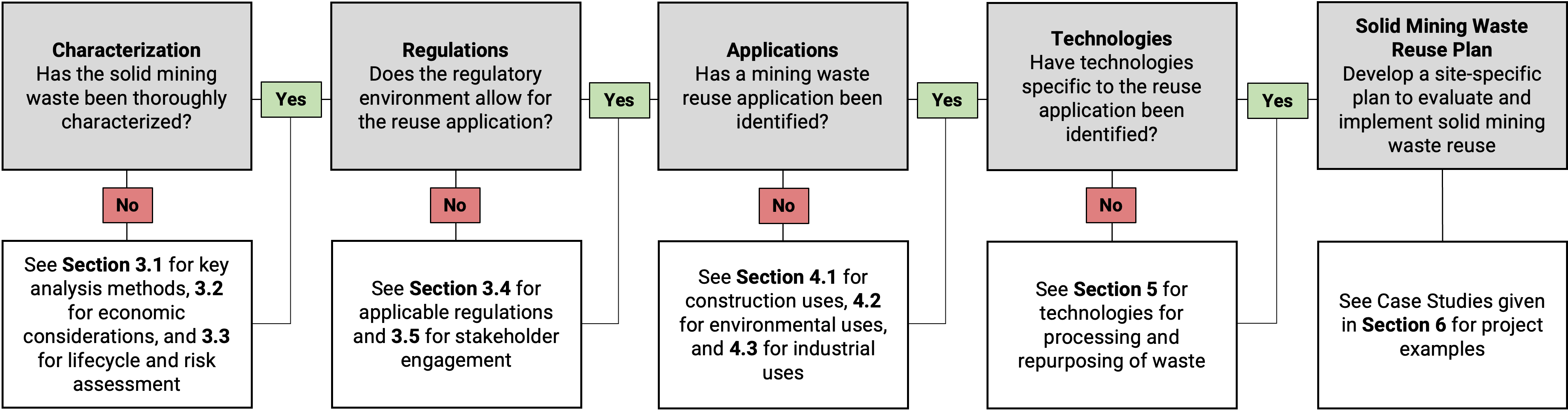
The overall purpose of this guidance is to provide an understanding of the issues and opportunities within the field of solid mining waste reuse for interested parties, their consultants, and other stakeholders, including those individuals who are looking for further guidance during the development and review of a site-specific solid mining waste reuse plan. Conceptually, solid mining waste reuse plans discuss the relevant site-specific technical and regulatory considerations associated with the intended waste reuse application. These plans will vary based on relevant jurisdiction, but should generally include waste characterization, technical feasibility, LCA and risk assessment, regulatory restrictions, and stakeholder considerations. Solid mining waste reuse plans must evaluate and mitigate potential environmental impacts on a site-specific basis to protect human health and the environment. An overview of these considerations is provided in this document, but specific plan requirements are beyond the scope of this guidance document (Figure 1-1).
Section 4.2
Figure 1-1
Source: Samantha Fuchs, Geosyntec
This guidance will include general best practices for characterizing and understanding the potential applications for reuse of solid mining waste. Characterization includes physical, geochemical, mineralogical, radiological, and toxicological evaluations. These parameters inform the potential applications for reuse of the solid mining waste. Additionally, key risk considerations will be provided to avoid inappropriate reuse, such as reuse of a material in an application that could increase harm to human health and the environment. This guidance will also provide a review of suggested technology and processes to transform solid mining waste into materials with beneficial uses.
The regulatory environment for solid mining waste reuse is complex. This guidance provides an overview of current laws and regulations at federal, state, and tribal levels that may be applicable to a solid mining waste reuse project. These regulations are highly specific to the site location, waste composition, and mine status. For instance, overburden from an active mine would have very different reuse requirements for potential reuse compared to waste rock at an abandoned site under the superfund program. Links to a variety of state, federal, and tribal agencies will be given for further information, and suggested contacts will be provided to address specific questions.
1.4 Guidance Organization
The overall structure of this guidance is provided in Figure 1-1. This guidance provides detailed information on key topics relevant to the reuse of solid mining waste. The scope of mining and mining waste issues is discussed (Section 2). Characterization and evaluation practices for the purposes of understanding existing solid mining waste are described (Section 3.1), as well as economic considerations (Section 3.2), LCA and risk assessment (Section 3.3), regulatory considerations (Section 3.4), and stakeholder engagement (Section 3.5). The possibilities for reuse of solid mining waste are discussed through potential resource recovery applications, including key contexts for viability based on human health and environmental risk assessment and economic feasibility (Section 4). The current state and practice of technological processes needed to reprocess solid mining waste is discussed (Section 5). Finally, several case studies are provided to exemplify the range of types of sites and potential reuse technologies and applications (Section 6).