The mining industry supplies essential material for construction, energy, and technological development around the world. The process of identifying and extracting ore for development produces billions of tons of waste. The existing and future need for resources produced from mining is projected to increase with continued development, especially in the energy sector (Section 2.1). Common mined materials include a variety of geological materials and minerals (Section 2.2). Several different types of waste are produced following extraction, with a variety of physical and chemical compositions (Section 2.3). Mining waste represents several potential physical and chemical hazards to human health and the environment. Although the mining industry is projected to continue to be the world’s largest producer of waste, intentional practices can reduce the hazards of solid mining waste (Section 2.4).
2.1 Status and Future of the Global Mining Industry
Worldwide, the generation of solid mining waste from the primary production of mineral and metal commodities has been estimated at more than 100 billion tons ( Tayebi-Khorami et al. 2019 [QUWRXA3N] Tayebi-Khorami, Maedeh, Mansour Edraki, Glen Corder, and Artem Golev. 2019. “Re-Thinking Mining Waste through an Integrative Approach Led by Circular Economy Aspirations.” Minerals 9 (5). https://doi.org/10.3390/min9050286. ). As of 2023, the global mining footprint is estimated at more than 100,000 km2, with 50% of this footprint consisting of waste storage facilities or permanent waste disposal locations ( Valenta et al. 2023 [S64NIG36] Valenta, Rick K., Éléonore Lèbre, Christian Antonio, et al. 2023. “Decarbonisation to Drive Dramatic Increase in Mining Waste—Options for Reduction.” Resources, Conservation and Recycling 190. https://doi.org/10.1016/j.resconrec.2022.106859. ). These wastes are generated during different stages of the mining process, which include exploration, mine development, mineral extraction, mineral processing (in other words, mineral beneficiation), refining, reclamation, and remediation. Market projections indicate that the demand for minerals will continue to increase on a large scale ( Aguilar et al. 2023 [PAKVLFMP] Aguilar, Tatiana, Francisco Betti, and Fernando Gomez. 2023. “Mining and Metals: Trends, Challenges and the Way Forward. Community Report. December 2023.” World Economic Forum. https://www3.weforum.org/docs/WEF_Mining_and_Metals_2023.pdf. ). One key aspect driving continued mining operations is the need for materials for carbon-neutral technology and industrial development. Decarbonization is driving the expansion of renewable power generation and the shift from combustion engines to electric vehicles. A global commitment to an energy transition has heightened the focus on materials security. In April 2023, the Group of 7 (Canada, France, Germany, Italy, Japan, the European Union, the United Kingdom, and the United States) adopted a Five-Point Plan for Critical Minerals Security, which acknowledged the increasing global demand for critical materials for the clean energy transition. The plan implements five points: forecasting long-term supply and demand, responsibly developing resources and supply chains, promoting critical minerals recycling, promoting resource-saving innovations and substitute technologies, and preparing for supply disruptions ( G7 Ministers of Climate, Energy and Environment 2023 [YLVNL7AN] G7 Ministers of Climate, Energy and Environment. 2023. “Annex to the Climate, Energy and Environment Ministers’ Communiqué. Five-Point Plan for Critical Minerals Security.” https://www.env.go.jp/content/000128287.pdf. ).
Specific minerals are required for new technology development. The energy transition will require significant amounts of raw materials, including lithium, nickel, REEs, copper, and aluminum ( Azevedo et al. 2022 [5ESW9XXW] Azevedo, Marcelo, Magdalena Baczynska, Patricia Bingoto, Greg Callaway, Ken Hoffman, and Oliver Ramsbottom. 2022. “The Raw-Materials Challenge: How the Metals and Mining Sector Will Be at the Core of Enabling the Energy Transition.” Mackenzie & Company. https://www.mckinsey.com/industries/metals-and-mining/our-insights/the-raw-materials-challenge-how-the-metals-and-mining-sector-will-be-at-the-core-of-enabling-the-energy-transition. ). For example, the global demand for refined copper is projected to increase from 25 million tons in 2021 to 53 million tons in 2050 ( S&P Global 2022 [37JCISQ5] S&P Global. 2022. “The Future of Copper: Will the Looming Supply Gap Short-Circuit the Energy Transition?” https://cdn.ihsmarkit.com/www/pdf/1022/The-Future-of-Copper_Full-Report_SPGlobal.pdf. ). Based on current supply trends, there could be up to a 20% shortfall in the copper required to meet the 2050 net-zero climate goal. Meeting this demand would require additional mines and recycling facilities ( Aguilar et al. 2023 [PAKVLFMP] Aguilar, Tatiana, Francisco Betti, and Fernando Gomez. 2023. “Mining and Metals: Trends, Challenges and the Way Forward. Community Report. December 2023.” World Economic Forum. https://www3.weforum.org/docs/WEF_Mining_and_Metals_2023.pdf. ). Applications of critical minerals and energy transition minerals are discussed further in Section 4. Additionally, specific sectors such as road transportation and power generation are materials intensive; to build new components with reduced carbon emissions, more physical materials are needed ( Azevedo et al. 2022 [5ESW9XXW] Azevedo, Marcelo, Magdalena Baczynska, Patricia Bingoto, Greg Callaway, Ken Hoffman, and Oliver Ramsbottom. 2022. “The Raw-Materials Challenge: How the Metals and Mining Sector Will Be at the Core of Enabling the Energy Transition.” Mackenzie & Company. https://www.mckinsey.com/industries/metals-and-mining/our-insights/the-raw-materials-challenge-how-the-metals-and-mining-sector-will-be-at-the-core-of-enabling-the-energy-transition. ). Even with an increased focus on sustainability and improvements in efficiency, waste will continue to be generated at an accelerated pace due to demand.
The role of the mining industry in the U.S. economy is shown in Figure 2-1. In 2023, the value of nonfuel minerals produced at mines in the United States was approximately $105 billion, with net exports of mineral raw materials estimated at $4.7 billion ( USGS 2024 [2W482Y5Q] USGS. 2024. “Mineral Commodity Summaries 2024: U.S. Geological Survey.” https://doi.org/10.3133/mcs2024. ). Nevertheless, the United States relied on imports for more than 50% of the country’s nonfuel mineral consumption. Most imports come from China and Canada ( USGS 2024 [2W482Y5Q] USGS. 2024. “Mineral Commodity Summaries 2024: U.S. Geological Survey.” https://doi.org/10.3133/mcs2024. ).
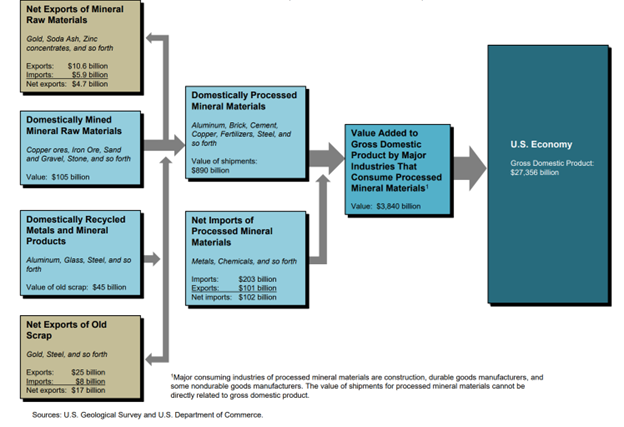
Figure 2-1. Role of nonfuel mineral materials in the U.S. economy in 2023.
Source: U.S. Geological Survey (
USGS 2024 [2W482Y5Q] USGS. 2024. “Mineral Commodity Summaries 2024: U.S. Geological Survey.” https://doi.org/10.3133/mcs2024.
)
2.2 Common Mined Materials
Different types of materials are mined for various purposes, from construction to energy to commodities. The type of mined materials influences the solid mining waste typically produced during mining. Mining processes vary based on the local geology and geography, type and grade of the ore deposit, age of the mine, available technology, and federal, state, and tribal regulations.
Common mined materials include the following:
- Metals
- Coal
- Oil Shale
- Limestones
- Clays
- Construction Aggregates (including sand, gravel, and crushed stone)
- Chalk
- Gemstones
- Rock Salt
- Other Nonfuel/Nonmetal Mineral
A diagram showing the value of nonfuel mineral commodities produced in the United States is shown in Figure 2-2. The state with the highest mineral commodity value is Texas, which produces construction aggregates and industrial materials like sand and gravel, crushed stone, cement, and lime ( USGS 2024 [2W482Y5Q] USGS. 2024. “Mineral Commodity Summaries 2024: U.S. Geological Survey.” https://doi.org/10.3133/mcs2024. ). Other leading states produce metals in addition to construction aggregates and industrial minerals. For example, Arizona produces copper and molybdenum mineral concentrates, and Nevada produces copper and gold.
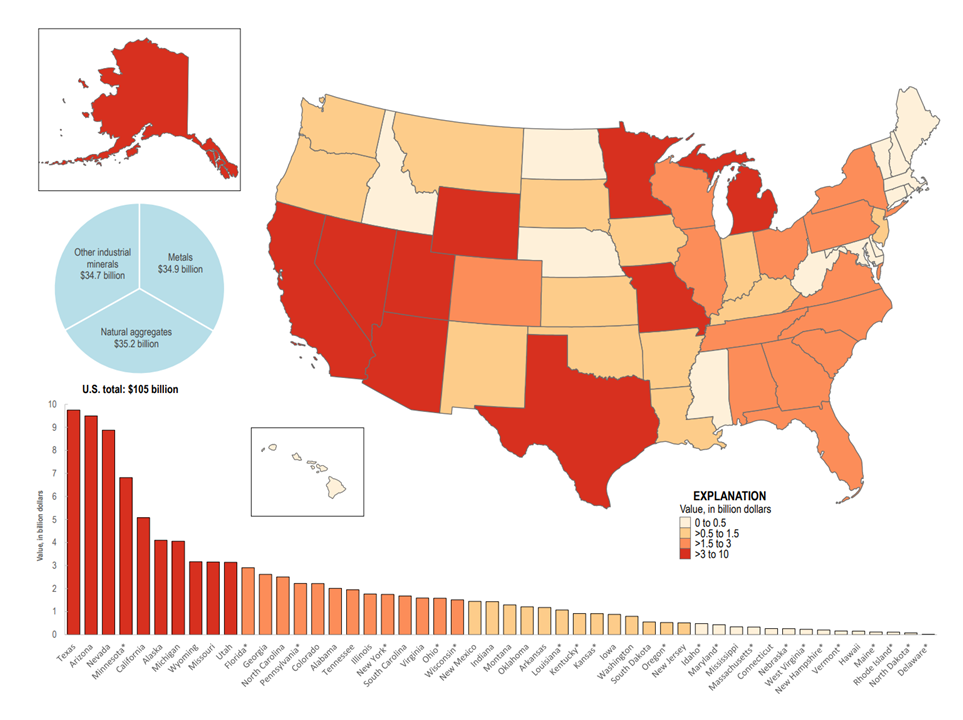
Figure 2-2. Value of nonfuel mineral commodities produced in 2023, by state.
Source: U.S. Geological Survey (2024b)
The major processing and recovery phases of the mining process are shown in Figure 2-3. Many of these processes and required technologies are similar for mining and the reuse of mining waste and are further described in Section 5.
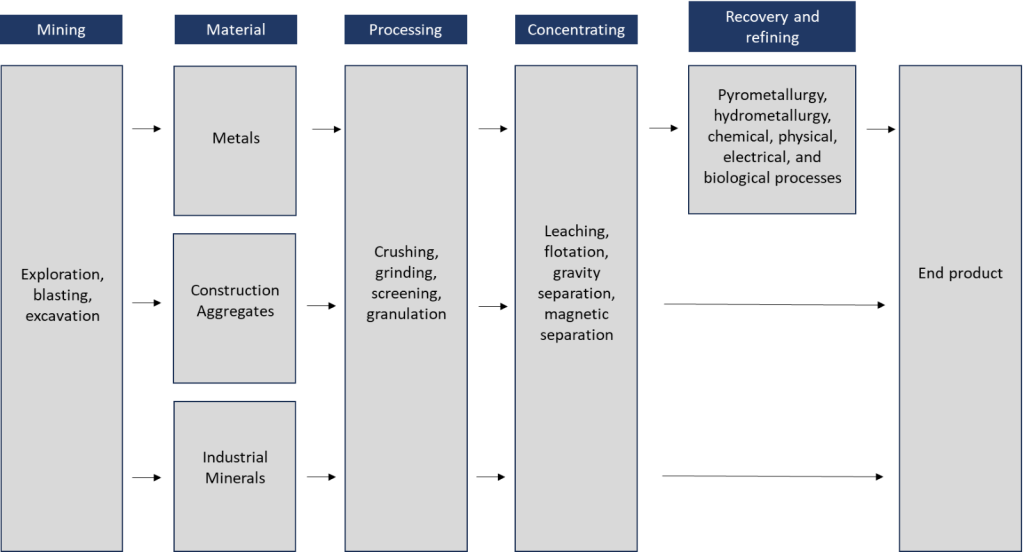
Figure 2-3. Major phases of the mining process.
Source: Stephanie Aurelius, Geosyntec
2.3 Common Types of Mining Waste
Generally, mining and metallurgical wastes are heterogeneous materials that can include ore, gangue, industrial minerals, metals, coal or mineral fuels, rock, loose sediment, mill tailings, metallurgical slag, roasted ore, flue dust, ash, and processing chemicals and fluids ( Hudson-Edwards et al. 2011 [CU85F7M5] Hudson-Edwards, Karen A., Heather E. Jamieson, and Bernd G. Lottermoser. 2011. “Mine Wastes: Past, Present, Future.” Elements 7 (6): 375–80. https://doi.org/10.2113/gselements.7.6.375. ). Although the primary commercial extraction of desired materials has already occurred, solid mining wastes can be a source of additional value. For example, slag is a by-product or waste material generated by high-temperature metallurgical processing or pyrometallurgical processing of ores or mineral concentrates; however, a properly characterized slag can be used as a concrete aggregate in construction, a source of phosphate for fertilizer, or as an acid neutralizer for acid mine drainage (AMD). For more information on the technological processes involved in mining and the production of mining waste, see Section 5.
Due to the amount and variety of solid mining waste, sustainable and environmentally responsible reuse would beneficially decrease the volume of waste and allow redevelopment or reclamation of the land (for examples see Sections 6.1.3.3 and 6.2.5). In order to evaluate the reuse of solid mining waste, the material must first be characterized to identify its physical and chemical composition. Waste characterization is key to determining a possible end use as well as current and future environmental and human health risks. Solid waste characterization is described in Section 3.1.
Multiple organizations employ variable definitions for mining wastes, but for the purposes of this guidance, common mining waste types are summarized in Table 2-1 and shown in Figure 2-4.
Table 2-1. Description of various types of mining wastes
| Mining Waste Type | Description |
| Chat | A local name in Oklahoma, Kansas, and Missouri for coarse-sized mining waste material produced from mill discharges during mineral processing operations such as crushing, gravity separation, and concentrating processes. Typically refers to fine gravel to sand-sized particles. |
| Gangue* | The minerals without value in an ore; that part of an ore that is not economically desirable but cannot be avoided when mining the deposit. It is separated from the ore during beneficiation. |
| Leachate | A solution or suspension formed when liquid travels through a solid and removes some components of the solid. These components may be dissolved or suspended within the liquid. |
| Mining-Influenced Water* | Any water affected by mining, milling, or smelting activities. This includes groundwater, surface water, acid mine drainage, acid rock drainage, and mine-impacted water. |
| Mining-Influenced Water Residuals | Materials formed or accumulated from various physical processes, chemical reactions, or biological reactions, which includes natural oxidation and reduction reactions, settling of suspended solids, and chemical and biological treatment processes. |
| Overburden* | Material of any nature, consolidated or unconsolidated, that overlies a deposit of useful and minable materials or ores, especially those deposits that are mined from the surface by open cuts or pits. |
| Slag | By-product of ore smelting. Main types of slag include ferrous, ferroalloy, and nonferrous. |
| Slimes* | Material of silt or clay in size, resulting from the washing, concentration, or treatment of ground ore. |
| Tailings* | The solid waste product (gangue and other material) resulting from the milling and mineral recovery process (washing, concentration, or treatment) applied to the ground ore. This term is usually used for sand to clay-sized refuse that is considered too low in mineral values to be treated further, as opposed to the concentrates that contain the valuable mineral or metal. |
| Waste Rock | All nonvaluable rock that is excavated during mining operations. Also known as development rock, it refers to cobble to boulder-sized material, although weathering of rock material especially at older abandoned mines, results in degradation to finer particle-size fractions. |
*Definitions are from ITRC ( ITRC 2010 [TVXDREGF] ITRC. 2010. “Mining Waste Treatment Technology Selection.” Interstate Technology and Regulatory Council. https://projects.itrcweb.org/miningwaste-guidance/index.htm. )
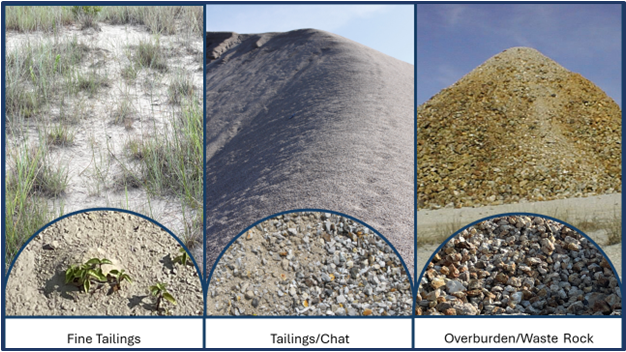
Figure 2-4. Relative grain size comparison for several types of mining waste.
Source: Interstate Technology & Regulatory Council Reuse of Solid Mining Waste Team
2.4 Mining Waste Hazard Reduction
Mining waste can pose a significant number of physical and chemical hazards to human health and the environment. Some potential hazards and impacts are listed below:
- Waste pile hazards. Waste rock, also known as development rock and including overburden and gangue, refers to all nonvaluable rock that is excavated during mining operations. In the past, waste rock was often dumped in large piles near the mine site. This leads to issues such as changes in drainage and erosion patterns, sediment loading to surface waters, slope failure, acid and alkaline mine drainage, and dispersal of contaminants into the environment. Contaminants include but are not limited to metals, metalloids, sulfides, and radioactive minerals. For further information on radioactivity hazards in mining waste, see Section 2.5.
- Tailings impoundment hazards. Tailings are the waste materials left over after the valuable minerals have been extracted from the ore and typically contain significant fluids from the ore refinement process. In traditional mining methods, tailings are often stored in large impoundments or tailings dams that pose geotechnical, geochemical, and environmental risks such as dam failures through piping or overtopping and surface and groundwater contamination. Fine-grain tailings can also pose risks due to wind-blown dusts. Tailings dam failures can cause immediate infrastructure damage, loss of life, and long-term environmental damage from the release of contaminants, such as arsenic and mercury. The Brumadinho Dam disaster in 2019 at the Córrego do Feijão iron-ore mine in Brazil resulted in the deaths of 270 people after a catastrophic tailings dam failure. The mudslide traveled 10 km, ultimately reaching the Paraopeba River and causing sediment and toxic contaminant loading ( Silva Rotta et al. 2020 [ZR7NQ89W] Silva Rotta, Luiz Henrique, Enner Alcântara, Edward Park, et al. 2020. “The 2019 Brumadinho Tailings Dam Collapse: Possible Cause and Impacts of the Worst Human and Environmental Disaster in Brazil.” International Journal of Applied Earth Observation and Geoinformation 90. https://doi.org/10.1016/j.jag.2020.102119. ).
- Fluid production hazards. Mining processes may include fluids that present hazards to human health and the environment. For instance, the most common mining process for gold uses a solution of cyanide to leach gold from crushed ore. Contaminated fluids are often stored on-site as part of a treatment process, such as in settling, precipitation, and evaporation ponds. In the event of accidents or improper construction, contaminated fluids can be released into the environment. For example, the Gold King Mine release occurred when excavation during investigation caused pressurized water to leak into the mining tunnel and into the surrounding environment ( Water Resources Mission Area 2018 [ELRCS8TZ] Water Resources Mission Area. 2018. “Gold King Mine Release (2015): USGS Water-Quality Data and Activities.” May. https://www.usgs.gov/mission-areas/water-resources/science/gold-king-mine-release-2015-usgs-water-quality-data-and. ).
Fluid leaching and drainage hazards include the following:
- Acid mine drainage. AMD is an environmental concern associated with mining activities. It occurs when some sulfide minerals in the waste rock or tailings come into contact with air and water, leading to the formation of sulfuric acid. This acid can then leach metals and other potentially toxic contaminants from the mining waste and discharge into nearby water bodies and groundwater aquifers, posing ecological and human health risks. Acid rock drainage results in a similar environmental concern, but the source of the rock is not necessarily affiliated with a mine. AMD typically has a pH of 2–6, but may also include circumneutral waters at pH 5–8 ( USGS 2016 [2FWHV2GI] USGS. 2016. “Acid Mine Drainage.” U.S. Geological Survey. Acid Mine Drainage. https://doi.org/10.1081/E-ESS3-120053867. ).
- Alkaline mine drainage. Alkaline mine drainage typically occurs in rocks containing calcite or dolomite. The raised pH can cause leaching of metals and other contaminants, posing risks similar to AMD.
Through pollution prevention and improved management processes, the human health and environmental impact of solid mining waste can be minimized. Many of these methods are already widespread. Overall, these advancements contribute to more responsible mining practices. Several hazard mitigation strategies can be employed as exemplified below.
- Resource recovery. With the advancement of mining technologies, there is an increasing emphasis on resource recovery from mining waste while it is still in the processing circuit, prior to disposal. Modern mining technologies enable the extraction of additional valuable minerals from the waste stream. For example, techniques such as flotation, leaching, and bioleaching are used to recover valuable metals from tailings or low-grade ores. This not only reduces the amount of waste generated but also maximizes the use of resources and may reduce the environmental footprint of mining operations.
- Waste pile management. With the advancement of mining technologies, waste pile management has become more sophisticated. Techniques such as cemented backfilling, where waste rock is used to fill underground voids, and reclamation, where waste rock is capped, reshaped, and revegetated, are now commonly employed to reduce the environmental impact of waste rock disposal. Separating waste rock based on type can allow for safer management or future use, such as separation of acid-generating rock and non-acid-generating rock, or separation of radioactive materials for disposal. Finally, best management practices include liners, covers, and leachate collection and removal to prevent environmental release.
- Tailings impoundment management. Best practices for management of tailings impoundments are to ensure both geotechnical and geochemical stability. Different types of tailings management tailored to the specific site conditions may help to reduce environmental risk from structural failure or contaminant release. One proactive form of tailings management includes “dry stacking,” where the tailings are filtered to reduce water content (generally to less than 20% liquid by weight), which causes the material to behave more like dry soil. This allows disposal in sequential, compacted lifts through conventional trucking or conveyance methods. Another alternative method involves changing rheology characteristics and dewatering to produce “thickened” or “paste” tailings ( Väätäinen [BTZUAKET] Väätäinen, Jari nd. n.d. “Removal of Water.” Mine Closure. https://mineclosure.gtk.fi/removal-of-water/. ). Thickened tailings are formed by dewatering or filtering to create a slurry with higher solids content and yield stress where the solids can still eventually settle freely. Paste tailings are dewatered more than thickened tailings to create a viscous, nonsegregating mixture. Both thickened and paste tailings can be disposed of within surface containment facilities or as backfill within underground workings, depending on site conditions ( Verburg 2001 [SUF98M7E] Verburg, Rens B. M. 2001. “Use of Paste Technology for Tailings Disposal: Potential Enviornmental Benefits and Requirements for Geochemical Characterization.” IMWA Symposia, Proceedings 2001 (Belo Horizonte, Brazil). https://www.imwa.info/imwaconferencesandcongresses/imwa-symposia/174-proceedings-2001.html. ). In some cases, cement or other binders may be added to increase the strength of the material.
- Acid mine drainage management and treatment. Mining processes focus on preventing or minimizing AMD through various methods as specified by regulations. These methods can be active or passive. Treatment methods include neutralization, electrocoagulation, evaporation, bioremediation, and encapsulation of sulfide-bearing materials to prevent contact with air and water. Management methods include caps, liners, leachate collection, and overall water management systems to control the flow of water to or through the waste.
- Speculative Accumulation. For waste products that cannot be eliminated or processed for further recovery, it is beneficial to consider potential future uses when evaluating disposal of the waste. That is, the process by which mining waste is initially stored or accumulated greatly affects the potential future uses of that waste. Speculative accumulation of mining waste refers to the practice of stockpiling or storing mining waste materials with the expectation of future economic gain or use. Advances in technology, changes in market conditions, or new environmental regulations, policies, or incentives may make it economically viable to recycle, reprocess, or otherwise extract valuable minerals or resources from previously discarded waste material. Governments or regulatory bodies may also introduce stricter regulations on waste disposal, leading mining companies to hold onto waste materials in anticipation of future recycling or reclamation opportunities. Speculative accumulation encourages the management of mining waste with the potential for future reuse or reprocessing in mind. Nevertheless, speculatively accumulated mining waste must still be appropriately managed to minimize environmental and human health hazards until a future use or disposal method is undertaken.
2.5 Potential Radioactivity in Mining Waste
Radioactive elements (also known as radionuclides or radioisotopes) are (1) naturally occurring and have varying activity levels based on the native soil and geology type, (2) can be concentrated through human activity such as mining and mineral processing, and (3) can be present in mining waste. The U.S. Environmental Protection Agency (USEPA) memorandum entitled “Potential for Radiation Contamination Associated with Mineral and Resource Extraction Industries” ( USEPA 2003 [RHRWQP9J] USEPA. 2003. “Potential for Radiation Contamination Associated with Mineral and Resource Extraction Industries. Memorandum.” https://semspub.epa.gov/work/HQ/189962.pdf. ) expands on this point:
“Radioactive contaminants at mines or mineral processing/manufacturing facilities are often overlooked in site assessments, inspections, site investigations, environmental impact statements, or site cleanups. Such omissions may occur because the radioactivity is unexpected or because the principal mineral(s) being mined or processed were not suspected to be radioactive. However, the geological emplacement or geothermal phenomena which formed other valuable minerals may have also concentrated radioactive minerals as well, or the process of mining, beneficiation, and milling may have resulted in a concentration of the radioactive minerals in the waste. In some instances, the mineral(s) being mined may have radioactive elements included in their molecular structure which imparts radioactivity to the ore or even the finished product.”
Common radioactive elements include uranium, thorium, and their decay products, radium and radon. Radon gas is a known carcinogen that can lead to lung cancer; thus, human exposure to radionuclides that produce radon gas as a decay product is often a driving concern when dealing with radioactive elements.
Naturally occurring radioactivity is commonly referred to as naturally occurring radioactive material (NORM). Human activities that have concentrated or increased exposure to NORM are commonly referred to as technology-enhanced naturally occurring radioactive material (TENORM). Both NORM and TENORM require careful management to minimize health and environmental risks associated with their presence for the following reasons:
- Radiation Exposure Risk. NORM and TENORM contain radioactive elements that can pose health risks if not properly managed. Assessing their presence helps in determining potential radiation exposure risks to workers and the environment.
- Regulatory Compliance. Presence of applicable or relevant and appropriate regulations regarding the handling of radioactive materials. By assessing NORM or TENORM in mining waste, stakeholders can ensure they comply with these regulations. Regulatory considerations are discussed in Section 3.4.
- Environmental Impact. Understanding the levels of NORM or TENORM in mining waste helps in the evaluation of potential environmental impacts when considering waste reuse applications.
- Worker Safety. Identifying the presence of radioactive materials is crucial for ensuring worker safety. Proper measures can be implemented to minimize exposure risks during the reuse of mining waste.
- Public Health. Assessing NORM or TENORM in mining waste reuse applications is important to safeguard public health, as any release of radioactive materials into the environment can have long-term consequences.
A project description emphasizing the need for careful management of NORM and TENORM waste is presented in Section 6.1.3.4 which discusses the Denver Radium Site and Uranium Mill Tailings Remedial Action sites in Colorado where legacy uranium and radium wastes were used in concrete aggregate due to poor planning and a lack of characterization, which led to increased public health risks.
Overall, the need for radiological surveys and/or testing may warrant further consideration to make informed decisions about the beneficial reuse of mining waste reuse. Radiological testing methods are described in Section 3.1.4.5.
Additional information can be found in the following references:
- USEPA web page on TENORM ( USEPA 2014 [2B3VXLYL] USEPA. 2014. “Technologically Enhanced Naturally Occurring Radioactive Materials (TENORM).” Technologically Enhanced Naturally Occurring Radioactive Materials (TENORM). https://www.epa.gov/radiation/technologically-enhanced-naturally-occurring-radioactive-materials-tenorm. )
- USEPA web page on Abandoned Mine Lands: Policy and Guidance ( USEPA 2015 [I5ZXTKAN] USEPA. 2015. “Abandoned Mine Lands: Policy and Guidance.” Abandoned Mine Lands: Policy and Guidance. https://www.epa.gov/superfund/abandoned-mine-lands-policy-and-guidance. )
- USEPA 2008 Technical Report on Technologically Enhanced Naturally Occurring Radioactive Materials from Uranium Mining (
USEPA 2008 [NJD6UMXV] USEPA. 2008. “Technical Report on Technologically Enhanced Naturally Occurring Radioactive Materials from Uranium Mining. Volume 1: Mining and Reclamation Background. EPA 402-R-08-0058.” U.S. Environmental Protection Agency. https://www.epa.gov/sites/default/files/2015-05/documents/402-r-08-005-v1.pdf.
)
- Volume 1 – Mining and Reclamation Background ( USEPA 2008 [NJD6UMXV] USEPA. 2008. “Technical Report on Technologically Enhanced Naturally Occurring Radioactive Materials from Uranium Mining. Volume 1: Mining and Reclamation Background. EPA 402-R-08-0058.” U.S. Environmental Protection Agency. https://www.epa.gov/sites/default/files/2015-05/documents/402-r-08-005-v1.pdf. )
- Volume 2—Investigation of Potential Health, Geographic, And Environmental Issues of Abandoned Uranium Mines ( USEPA 2008 [GESRCHBM] USEPA. 2008. “Technical Report on Technologically Enhanced Naturally Occurring Radioactive Materials from Uranium Mining.” In Volume 2: Investigation of Potential Health, Geographic, and Environmental Issues of Abandoned Uranium Mines. EPA 402-R-08-005.” U.S. Environmental Protection Agency. https://www.epa.gov/sites/default/files/2015-05/documents/402-r-08-005-v2.pdf. )
- USEPA 2003 Memorandum on Potential for Radiation Contamination Associated with Mineral and Resource Extraction Industries ( USEPA 2003 [RHRWQP9J] USEPA. 2003. “Potential for Radiation Contamination Associated with Mineral and Resource Extraction Industries. Memorandum.” https://semspub.epa.gov/work/HQ/189962.pdf. )
- Multi-Agency Radiation Survey and Site Investigation Manual or MARSSIM (USEPA-402-P-20-001) ( USEPA 2015 [QCLQUTJC] USEPA. 2015. “Download the MARSSIM Manual and Resources.” Download the MARSSIM Manual and Resources. https://www.epa.gov/radiation/download-marssim-manual-and-resources. )