Estate Types
Fee Simple or United Estate:
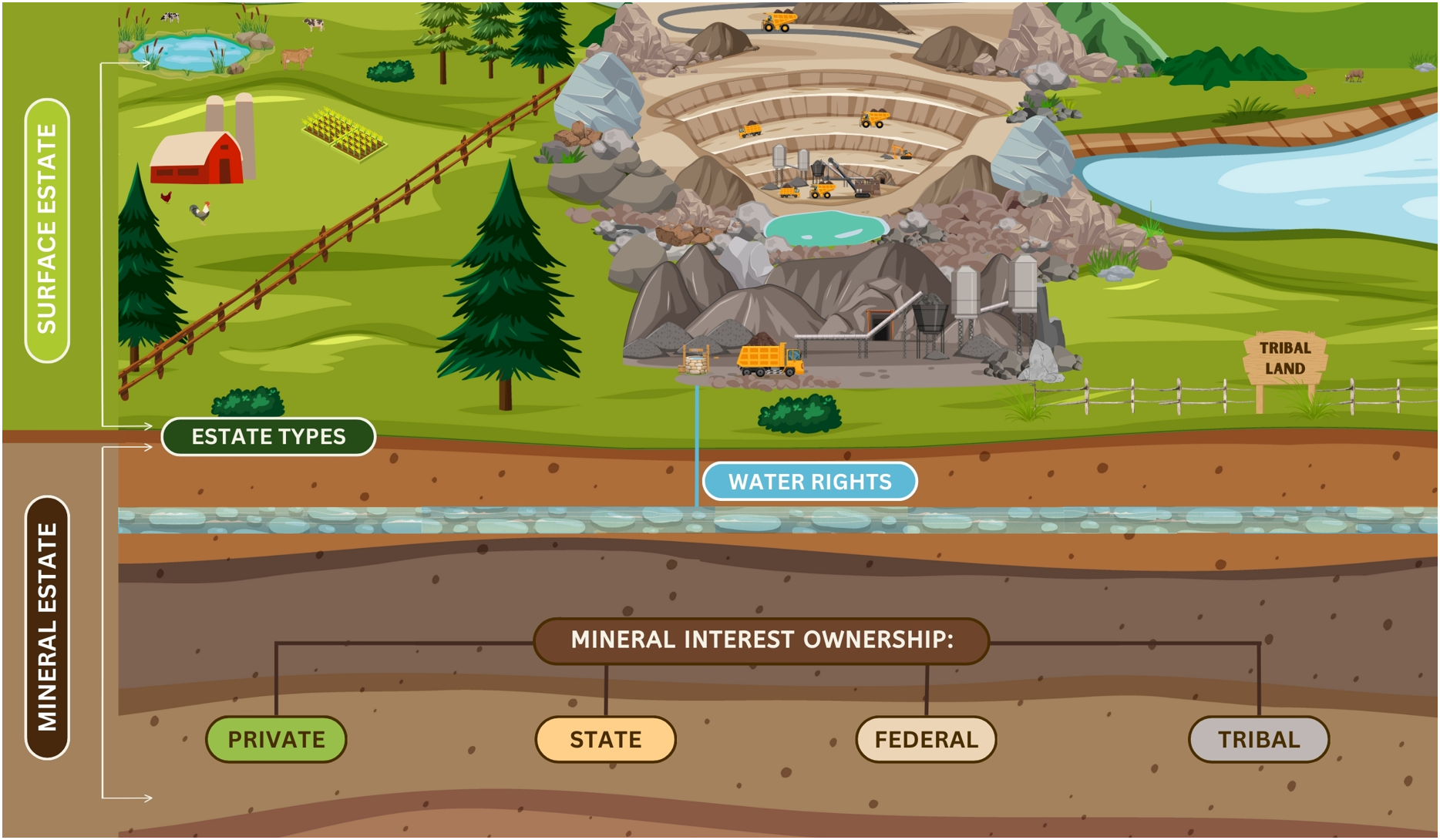
The surface & mineral rights are joined. The executive rights holder has control over both estates.
Severed or Split Estate:
The surface & mineral rights are separate. It is a fractional estate when the mineral rights are divided among multiple owners.
Water Rights
In the U.S., the use of water is controlled by the states. Typically, states have requirements regarding the use of water for mining-related activities. The specific requirements depend on the volume, quality, location, & type of water to be used.
Surface water rights may be granted if the project lies on lands bordering a natural waterway. The mining company may be required to own the lands to obtain surface water rights.
Groundwater rights may be granted if available in the project area. However, it's important to note that some basins have been allocated, and no new rights are available. Rights not exercised in some time may be denied for use.
Prospective mine waste reuse projects should carefully evaluate water requirements & availability. Community interest may be a significant factor, especially in water-scarce regions.
Surface Estate
Surface rights allow the owner to use the surface of the land for commercial, residential, agricultural, and other purposes, such as building, gardening, raising livestock, etc. Surface rights can encompass ownership, leasing, and various types of agreements that govern how the surface of the land can be used.
Mineral Estate
Mineral rights authorize the owner to explore, extract, and develop resources beneath the land’s surface, such as oil wells, mineral deposits, natural gas, etc. The mineral owner may also choose to lease, sell, or donate the mineral rights to an individual or company.
Private
Private mineral ownership is by individuals, companies, or organizations on privately owned land who purchase or inherit mineral rights.
Leasable minerals (oil, gas, coal): owners can lease their mineral rights to companies, retaining some rights while receiving royalties
Locatable minerals (metallic/nonmetallic minerals): owners can stake a claim and acquire rights separately from the surface rights; owners control the rights to extract minerals or to lease their rights to mining companies
Saleable minerals (common materials, sand, gravel): owners control minerals through permits & leases, extracting & selling the materials, or leasing the rights to companies to extract
Royalties can be negotiated with the companies extracting the minerals from their land and are usually based on the extracted quantity or value.
State
Some states retain ownership of minerals within their boundaries.
Leasable minerals (oil, gas, coal): states lease these minerals through lease agreements, often through competitive bidding processes
Locatable minerals (metallic/nonmetallic minerals): a mining claim can be made on these minerals, and once established the minerals can be extracted; minerals on state-owned land are made available under the individual state’s statutory and regulatory scheme
Saleable minerals (common materials, sand, gravel): on state-owned lands, these minerals can be permitted for extraction & usually with royalties paid to the state
Royalties from both leased & saleable material extracted from state-owned land are paid to the state government. Interests involve the rights given to companies to extract minerals.
Federal
Typically, the federal government retains ownership of minerals on federally owned lands.
Leasable minerals (oil, gas, coal): the federal government manages these minerals through agencies that lease rights to extraction companies through competitive bidding which must adhere to certain regulations set by agencies such as the Bureau of Land Management (BLM) or the Forest Service (USFS)
Locatable minerals (metallic/nonmetallic minerals): on federal lands, these minerals may require individuals or companies to stake claims or obtain permits for extraction; claims require maintenance fees and assessment work to maintain
Saleable minerals (common materials, sand, gravel): permits or leases manage these minerals to grant their extraction on federal lands, and royalties are paid to the federal government
Royalties from minerals extracted on federal lands are paid to the federal government, and revenue-sharing agreements allocate some of the royalties to the states where the mineral extraction occurred. Interests involve the rights granted to companies to extract materials while paying the government through royalties.
Tribal
Reservations on Federal lands in the U.S. are held by a treaty or administrative directive for specific Native American tribes or Alaska Natives, and the federal government holds title to the land in trust/restricted status for the benefit of a tribe or individual tribal member.
Leasable minerals: on Indian land, these minerals are owned by Native American tribes or individual tribal members and are subject to restrictions on leasing and development imposed by the federal government
Locatable minerals: on Indian land, these refer to valuable mineral resources that are subject to exploration and extraction under the General Mining Law of 1872; these minerals are typically owned by Native American tribes or individual tribal members and are governed by federal regulations and tribal ordinances
Saleable minerals: on Indian land, these minerals are owned by Native American tribes or individual tribal members and are suitable for extraction and sale in commercial markets; these minerals may include, but are not limited to, a variety of valuable resources such as oil, natural gas, coal, gravel, and sand and are subject to restrictions on sales and development imposed by the federal government
Royalties from extracted minerals are paid to the tribal government or designated managing body and distributed within the tribe. The Bureau of Indian Affairs (BIA) and other federal agencies may be involved in overseeing and managing the extraction process. The interests in extracting minerals from tribal lands are diverse and include economic, legal, environmental, and cultural dimensions.